Brand System / Musical instruments / audio / mobility / 1887-present
Yamaha and the Tuning-Fork System That Carried Sound Into Mobility
Yamaha made one mark carry reed organs, pianos, music schools, audio equipment, the YA-1 motorcycle, Yamaha Motor, and later industrial craft because the tuning-fork origin kept the brand anchored in sound.

Short Answer
Yamaha and the Tuning-Fork System That Carried Sound Into Mobility is a brand system case about Yamaha in 1887-present. A sound mark became a business bridge because Yamaha kept connecting craft, precision, product breadth, and experience back to the same tuning-fork memory. A diversified brand needs a first principle customers can still feel. Yamaha shows how sound, tuning, craft, and precision can carry from instruments into audio, education, motorcycles, marine products, and industrial work without making every category feel unrelated.
Key Takeaways
- Yamaha traces the brand to Torakusu Yamaha repairing a reed organ in 1887 and producing an organ in the same year.
- The company established Nippon Gakki Co., Ltd. in 1897 and adopted the tuning fork as the corporate mark in 1898.
- The tuning-fork mark gave later product expansion a memory that still pointed back to sound and precision.
- Yamaha's official history says 1955 brought the YA-1 motorcycle and Yamaha Motor Co., Ltd. as the motorcycle division split off.
- For operators, the lesson is to make diversification inherit a real proof system rather than asking a shared name to do all the work.
The Decision Context
Yamaha is useful because the brand did not stay inside one product class. It moved from reed organs and pianos into music education, audio, motorcycles, marine products, industrial machinery, components, and experience shops.
That kind of spread usually weakens recognition. Yamaha had a different starting point: the tuning fork. The mark gave the business a way to make expansion feel connected to sound, craft, precision, and performance.
The Origin Stayed Physical
Yamaha's official history starts with Torakusu Yamaha repairing a broken reed organ in 1887 and producing an organ shortly afterward. Nippon Gakki Co., Ltd. followed in 1897.
The tuning fork became the corporate mark in 1898. That matters because it is a tool, not a decoration. A tuning fork makes pitch inspectable. The mark gave the company a visual shorthand for exactness before the brand became broad.
The Logo Carried A Business Theory
Yamaha's logo history says the three tuning forks represent technology, production, and sales, while also evoking melody, harmony, and rhythm. The circle made the mark feel like a complete system, not a loose instrument reference.
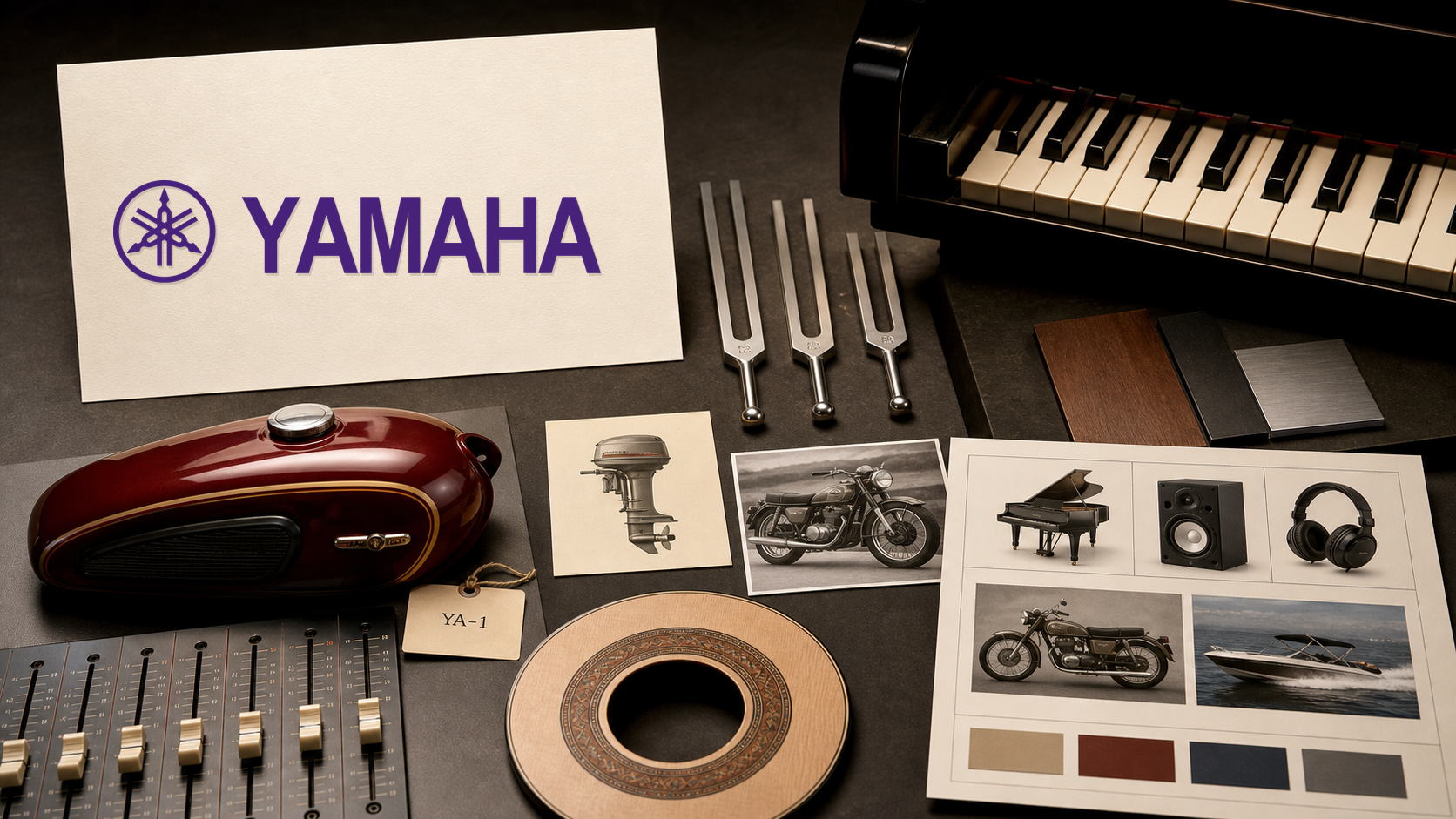
That is why the source-card treatment matters on this page. The logo is not an afterthought beside the case. It is the proof object that explains why piano keys, audio faders, guitar craft, a YA-1 tag, and marine cues can sit in the same archive frame.
Mobility Did Not Erase Music
Yamaha's history lists 1955 as the year it launched the YA-1 motorcycle and established Yamaha Motor Co., Ltd. after the motorcycle division split off. The category changed sharply. The brand memory did not have to disappear.
That move works as an archive lesson because Yamaha Motor could borrow the discipline of craft, precision, tuning, and performance without pretending a motorcycle is a piano. The shared name had something to inherit.
Breadth Needs A Center
Yamaha's current business page still describes musical instruments, audio equipment, and other industrial machinery and component businesses through sound, music, know-how, and manufacturing expertise.
That is the difference between breadth and sprawl. If a customer can feel the center, new categories have a chance to read as extensions. If the center is only a logo file, the brand becomes a holding label.
The Archive Reading
Yamaha belongs in the Brand Archive as a sound-to-mobility system. The strongest reading is not that one company sells many things. It is that the company kept one physical idea alive: tune the object, tune the experience, tune the system.
For operators, Yamaha is a warning against lazy diversification. A shared name earns its reach when customers can trace the proof. The mark, product behavior, origin story, and category logic have to keep answering the same question.
Comparable Cases
Sources

People Also Ask
What happened to Yamaha?
Yamaha and the Tuning-Fork System That Carried Sound Into Mobility is a brand system case about Yamaha in 1887-present. A sound mark became a business bridge because Yamaha kept connecting craft, precision, product breadth, and experience back to the same tuning-fork memory. A diversified brand needs a first principle customers can still feel. Yamaha shows how sound, tuning, craft, and precision can carry from instruments into audio, education, motorcycles, marine products, and industrial work without making every category feel unrelated.
Why is Yamaha a brand system case?
Yamaha is filed as a brand system case because the visible consequence sits in that decision pattern. A sound mark became a business bridge because Yamaha kept connecting craft, precision, product breadth, and experience back to the same tuning-fork memory.
What can brands learn from Yamaha?
A diversified brand needs a first principle customers can still feel. Yamaha shows how sound, tuning, craft, and precision can carry from instruments into audio, education, motorcycles, marine products, and industrial work without making every category feel unrelated.
Is Yamaha still operating?
The Brand Archive marks Yamaha as Active / continuing. That means the brand, company, platform, product system, or parent organization is still operating, continuing, or being actively resolved.
What should Yamaha be compared with?
Compare Yamaha with Sony, Honda, Toyota to see the same decision pattern from nearby cases.