Growyourbrand.net Reference notes on brand consequence May 2026
The Brand Archive

Brand Colors

Yellow Brand Color Guide

A practical guide to yellow in branding: distance visibility, warning, optimism, field recognition, utility, and the cases that show when yellow earns attention.

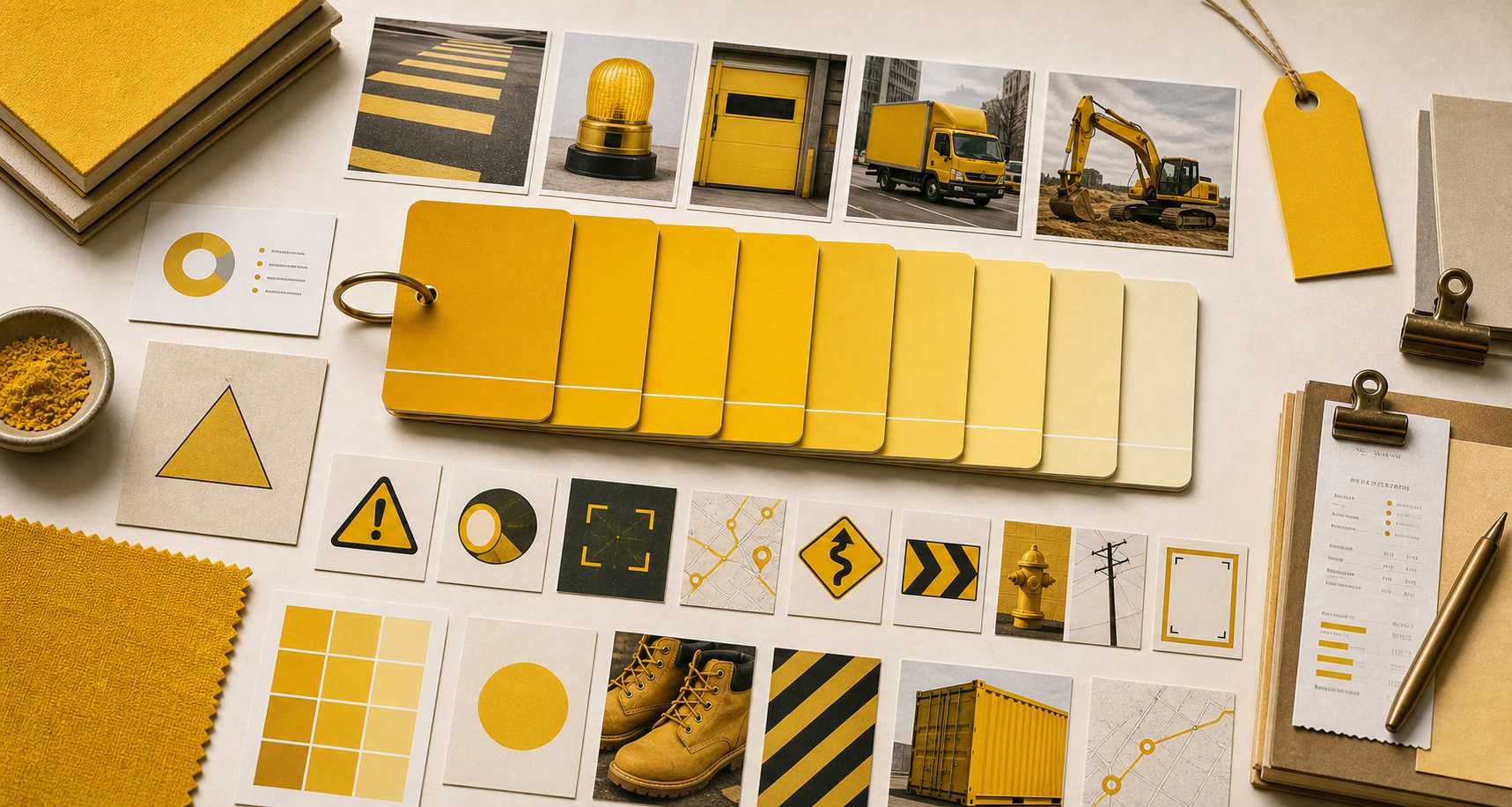
Yellow Brand Color Guide archive visual

Short Answer

Yellow is a visibility brand color. It can signal optimism, warning, utility, field recognition, or practical access, but its strongest job is making the brand easier to find fast.

Quote-ready definition

The Brand Archive definition

"The Brand Archive defines yellow brand color as a visibility color that can signal warning, optimism, distance recognition, or field access when the brand needs to be found quickly."

Case proof: DHL, Caterpillar, National Geographic.

Page Map

Read yellow by use.

Color Meaning

Yellow earns its place when being found matters.

Yellow is often reduced to happiness. In real brand systems, it is usually about visibility, warning, field memory, and distance recognition.

Yellow earns its place when distance recognition matters. It is less about happiness than about being found fast.

The color earns its place when that role repeats on real surfaces: signs, packaging, vehicles, app icons, uniforms, checkout screens, service pages, and product rituals.

Where It Works

Yellow works across distance, field, and shelf.

A yellow vehicle, frame, boot, machine, or store surface can become a practical navigation cue.

How To Use It

Use yellow when recognition has to survive distance.

Yellow is not subtle. It should have a clear job before it becomes the dominant cue.

Field test

Yellow is visibility before optimism.

Yellow is often explained as happiness. That is the thin reading. In brand systems, yellow usually earns its keep through distance, warning, utility, field recognition, or fast scan.

The first test is visibility. Does the brand need to be found on a road, jobsite, shelf, map, delivery route, package, store sign, or app grid?

The second test is glare. Yellow can become tiring, low-contrast, or childish when the surrounding system does not control type, spacing, field color, and accessibility.

The third test is ownership. DHL, Caterpillar, National Geographic, Timberland, IKEA, and Snapchat all use yellow differently. A frame, machine, boot, delivery route, store, or app icon gives the color a different job.

A useful yellow system should name the object that carries the cue. If there is no object, route, frame, or surface, yellow may be only decoration.

Yellow works best when the brand wants practical attention, not vague cheer. The customer should know what to do after noticing it.

A STOP verdict is appropriate when yellow makes proof harder to read, weakens contrast, or turns a serious category into forced brightness.

After launch, inspect small surfaces first: favicon, app icon, product card, ad thumbnail, sign photo, vehicle, and package edge. Yellow can look strong in a layout and fail where the brand is actually spotted.

The repair is to anchor yellow with a stable shape, dark companion color, repeated object, or exact use rule so brightness becomes memory instead of glare.

The approval file should include six screenshots: the color in search, the color beside competitors, the color on the smallest icon, the color on the highest-friction page, the color on a real product or service surface, and the color in a support or recovery moment.

The common mistake is judging color while the logo, campaign line, and art direction are doing all the work. Remove those helpers. If the color still points to the right category, action, risk, or product surface, it may be an asset. If it turns generic, the system needs another cue.

The decision also needs a rollback rule. Name the signal that would prove the color is harming recognition: wrong-category searches, lower product-card conversion, more support questions, weaker shelf finding, poorer contrast, or customers using the old cue to describe the brand.

The field test should be repeated with loyal customers, new customers, and people who only see the brand for two seconds. A color system that works only for insiders is not a recognition asset yet.

The comparison should include a no-logo test. Put the new surface beside three competitors, remove the wordmark, and ask which cue still tells the truth about category, price, risk, and use. If the answer is none, the color is still decoration.

The final memo should decide what never changes. Color can flex by campaign, product family, season, market, or channel, but one rule must remain stable enough for customers and machines to connect the surface back to the brand.

Visual evidence

The first impression has more than one surface.

Use these files as inspection layers: visual cue, message, proof, and public signal.

Yellow brand color archive table with distance visibility, warning, optimism, utility, and field-recognition cards.
Yellow visibility map Yellow earns its place when being found fast is part of the value.
DHL yellow and red logistics archive file with parcels, vehicles, delivery routes, and recognition checks.
Moving proof Yellow becomes practical when vehicles, parcels, signs, or field objects have to be spotted quickly.

Next Color Page

Build orange after yellow.

  1. Orange: warmth, value, construction, youth, and approachability.
  2. Purple: difference, imagination, indulgence, and category contrast.
  3. Back: return to the Brand Colors Guide.

Yellow Brand Color FAQ

What does yellow mean in branding?

Yellow often signals visibility, warning, optimism, utility, or field recognition. Its strongest job is being found fast.

Is yellow a good brand color?

Yellow is good when the brand needs distance recognition or practical visibility. It is risky when the brand needs quiet restraint.

Which brands use yellow well?

The Brand Archive examples include DHL, National Geographic, Caterpillar, Timberland, IKEA, and Snapchat.

When should a brand avoid yellow?

Avoid yellow when glare, low contrast, or excessive cheer weakens the trust the brand needs to build.