Brand Entity / Bud Light brand backlash
Bud Light: brand backlash
Bud Light is filed as an audience-signal brand: a small campaign artifact became a distribution and identity problem for a mass beer brand.
Short Answer
Bud Light is filed in The Brand Archive as a brand entity for Bud Light brand backlash. The Bud Light file proves that broad brands need audience-signaling discipline before a message enters public conflict.
What the Bud Light file proves
The page starts from filed GYB evidence, not a generic company history. That matters because brand-name demand usually arrives with a hidden modifier: logo, rebrand, failure, strategy, trust, comeback, or controversy.
The proof test is whether the archive can point to a decision and a consequence. If the page cannot do that, the brand stays in the index and does not get an entity page.
- The Bud Light file proves that broad brands need audience-signaling discipline before a message enters public conflict.
- The risk is letting a light campaign object become the brand's loudest social signal.
- Inspect how a low-cost post changed retailer, customer, political, and category readings of the brand.
- The entity page does not replace case pages. It gives the cases one parent so brand-name searches have a canonical home.
Mistake To Catch
Where the Bud Light reading breaks
The risk is letting a light campaign object become the brand's loudest social signal.
The weak read is to turn the brand into a famous-name profile. The stronger read is to ask which decision changed recognition, trust, habit, distribution, product proof, or public memory.
That is the traffic opportunity competitors miss. Logo farms answer the asset query. Agency blogs answer the strategy query with services nearby. This page connects the name, the asset, the decision, the source trail, and the lesson without turning into a pitch.
Decision timeline
The timeline is the reason this brand has a parent page. Each row points to a filed case, then names the consequence a reader should carry into the next comparison.
For brands with one case, the timeline still matters because it prevents a thin profile. The brand page becomes the router, and the case page remains the proof.
| Filed decision | What happened | What it teaches |
|---|---|---|
| Bud Light and the Audience Signal That Became a Distribution Problem Disaster / 2023-2024 |
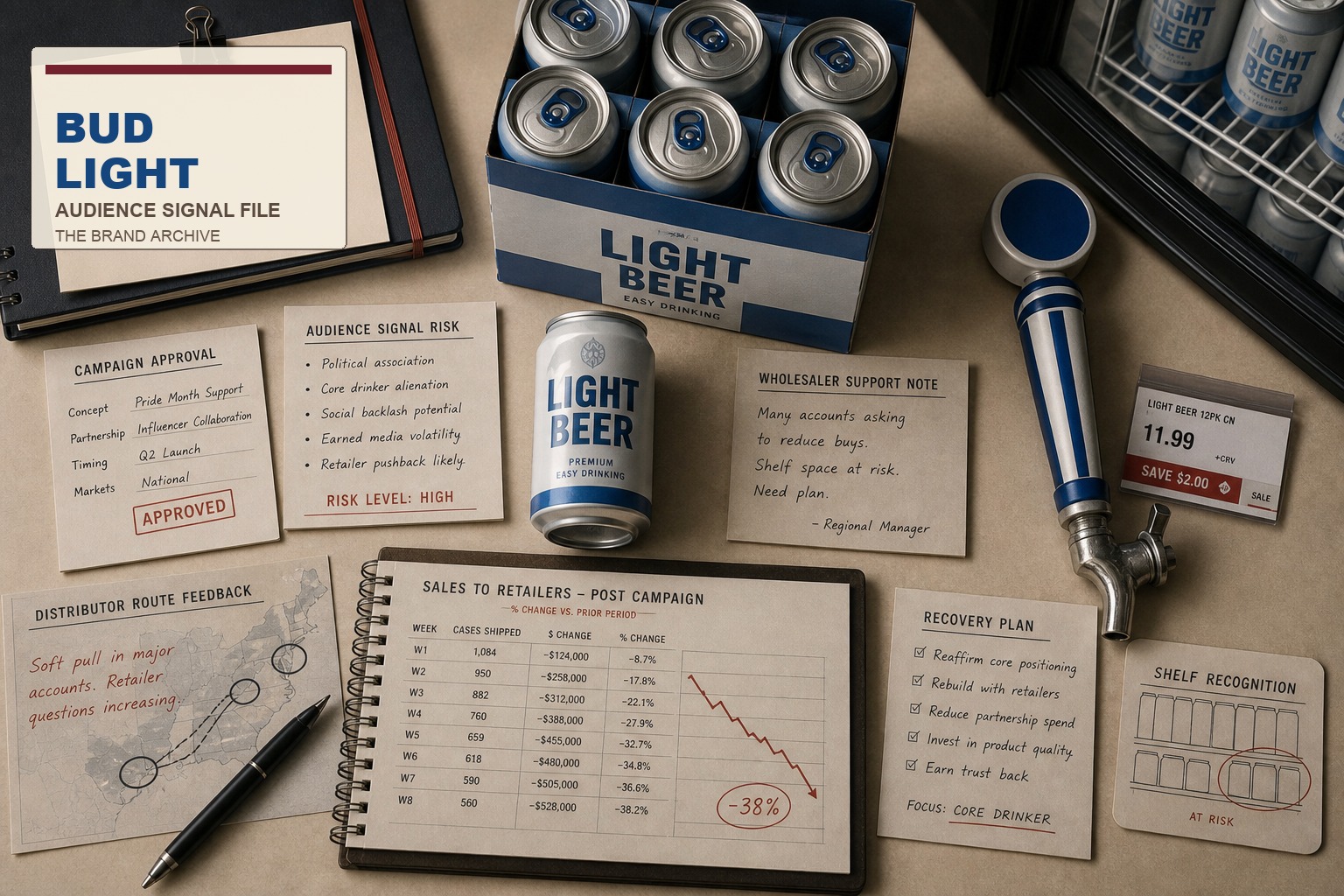
Bud Light showed how fast a mass-market beer brand can become a public signal problem when a small campaign artifact changes who the brand seems to be speaking for. | A sponsorship signal can carry more meaning than the spend behind it. When a broad-reach brand triggers opposing readings at once, the issue is not only backlash. It is whether distributors, retailers, loyal buyers, and new audiences all understand the same brand role. |
Source test
A brand page is allowed to rank only if the reader can inspect the public record. The source trail below is inherited from the filed cases, including company records, campaign records, public reports, source-mark files, or archived references where the original page moved.
The source test is simple: remove any sentence that cannot be supported by a filed case or a source already attached to that case. That keeps the entity layer closer to an encyclopedia than to a listicle.
Use this page when the search starts with Bud Light. Use the case links when the question becomes what changed, what broke, what worked, and what to compare next.
Visual proof
The hero image for this brand page uses the strongest generated archive visual already attached to the primary case: Bud Light and the Audience Signal That Became a Distribution Problem. It stays tied to filed evidence instead of becoming a generic brand mood image.
That visual rule matters for this build. Every brand page needs a high-end image, but the image has to point back to the decision: packaging, mark, product behavior, service proof, ritual, failure, or trust pressure.
If a future brand has no strong visual, it does not pass the entity-page gate until the image is generated or replaced.
Sources
People Also Ask
What happened to Bud Light?
Bud Light is filed in The Brand Archive as a brand entity for Bud Light brand backlash. The Bud Light file proves that broad brands need audience-signaling discipline before a message enters public conflict.
What is the Bud Light brand file?
Bud Light is filed in The Brand Archive as a brand entity for Bud Light brand backlash. The Bud Light file proves that broad brands need audience-signaling discipline before a message enters public conflict.
Why does Bud Light have a brand page?
The archive has 1 filed case for Bud Light, which gives the brand enough evidence for a parent entity page instead of a loose index link.
What should readers inspect first in the Bud Light case record?
Inspect how a low-cost post changed retailer, customer, political, and category readings of the brand.