Brand System / Banking / Financial services / 1865-present
HSBC and the Global Local Banking System Behind The Hexagon
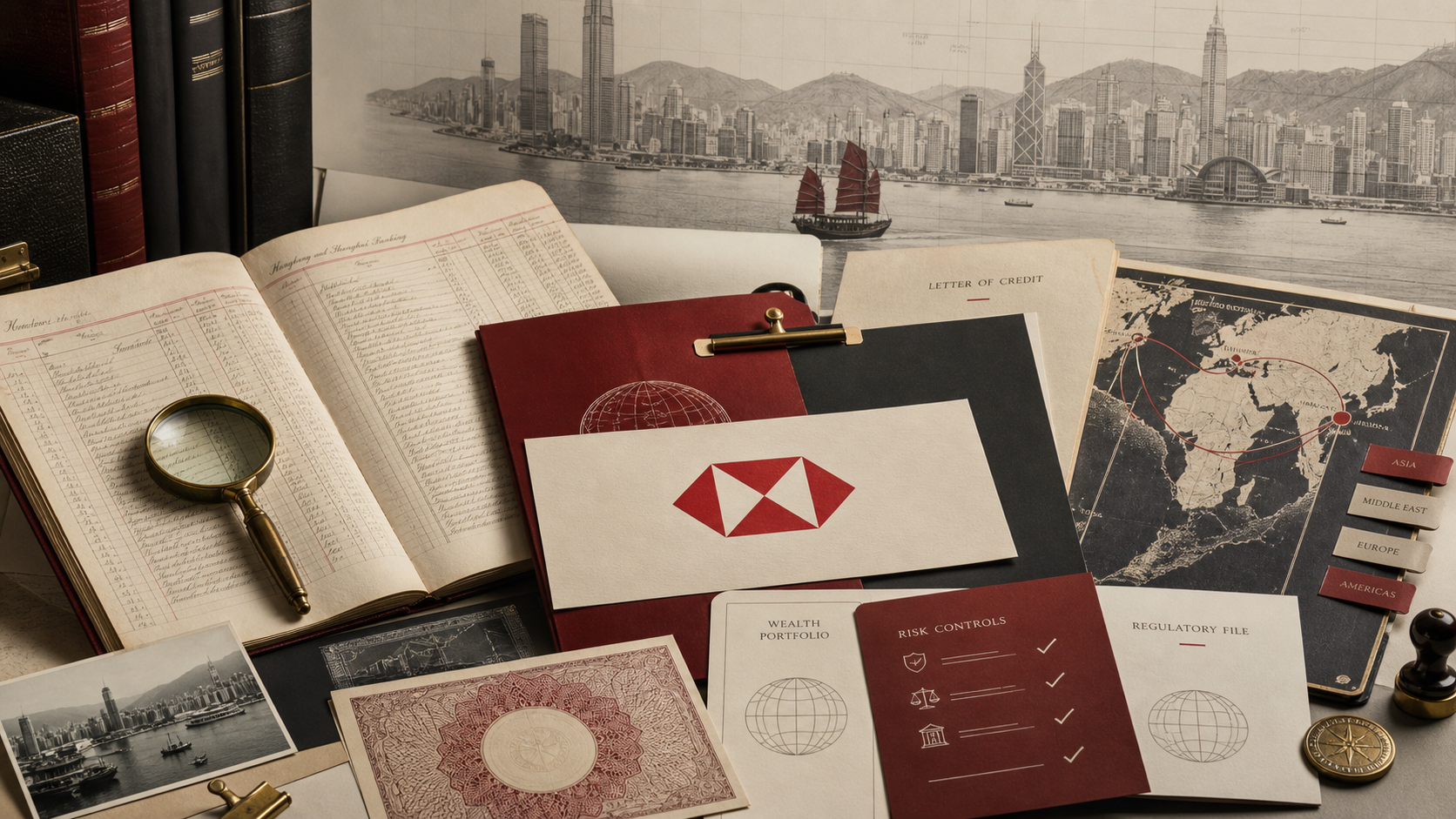
HSBC turned Hong Kong trade finance, a red-and-white house flag, the hexagon mark, branch trust, international banking, wealth, and risk control into one of the clearest bank brand systems in the world.

Short Answer
HSBC and the Global Local Banking System Behind The Hexagon is a brand system case about HSBC in 1865-present. HSBC made local banking feel international by making the same trust signal appear on branches, cards, trade documents, wealth accounts, and market entries. Bank brands sell confidence before they sell products. HSBC shows why a financial-services brand needs a visual system, a geography system, and a risk system that customers can read before they understand the balance sheet.
Key Takeaways
- HSBC says it opened for business in Hong Kong in March 1865 to finance trade between Europe and Asia.
- The bank's own brand history ties the hexagon to the original red-and-white house flag and to Henry Steiner's 1979 corporate identity work.
- HSBC says the 1998 and 1999 brand consolidation moved hundreds of subsidiary names under the HSBC name and hexagon.
- Its current history page says the group serves around 41 million personal, wealth, and corporate customers in 56 countries and territories.
- The reported Assume Nothing problem belongs in the case as a localization risk, not as the whole HSBC story.
- The operator lesson is to make a global promise survive local language, branch behavior, regulation, and risk.
The Decision Context
A bank brand has a harder job than most consumer brands. It has to make strangers trust a balance sheet, a counterparty, a card, a branch, a mobile app, and a legal entity they may never inspect.
HSBC belongs in the archive because its brand system comes from the problem it was built to solve: local banking for international trade. The mark, the name, the branch network, the Hong Kong origin, and the later global campaign all point back to that same operating problem.
Hong Kong Was The Starting Claim
HSBC's current history page says the bank opened in Hong Kong in March 1865 to finance trade between Europe and Asia. Its timeline gives the operating shape: the Hong Kong doors opened on 3 March 1865, Shanghai followed a month later, and London opened in July to handle foreign exchange for clients in China and India.
That origin matters because it keeps the brand from becoming a generic global-bank story. HSBC did not start as a bank that later discovered international clients. It started with trade, ports, currency, documents, and distance.
The Hexagon Made The System Portable
HSBC's brand-history page says the bank used a red-and-white house flag before it had an official logo. In 1979, Henry Steiner was engaged to build a corporate identity for HSBC businesses around the world, and the hexagon came from the house-flag geometry.
The archive reading is practical. A bank mark has to work on a tower, a card, a branch sign, an app icon, a stadium, a PDF, and a document footer. HSBC's hexagon became useful because it was simple enough to travel through every one of those surfaces.
The Unified Brand Was An Operating Move
The brand-history page says HSBC kept allowing member companies to use their own names for years. That changed at the end of the 1990s. HSBC's history timeline says the bank decided in 1998 to use the HSBC name and red-and-white hexagon worldwide.
The brand-history page gives the scale of the move: from 1999, more than 300 subsidiary names were brought under the HSBC name and hexagon. Long-standing names such as the British Bank of the Middle East and Marine Midland moved into the masterbrand.
That is the serious case. Brand architecture was not decoration. It reduced the amount of trust a customer had to rebuild every time HSBC crossed a border.
The World's Local Bank Was A Sharp Position
The phrase worked because it joined the two halves of the business: local banking knowledge and international reach. It told a client what HSBC was trying to make easy before the client had to read a product page.
It also made the system vulnerable. A global line has to survive local interpretation. When a bank sells judgment, translation is not a finishing step. It is part of the product.
The Assume Nothing Lesson Belongs Here, Carefully
HSBC is often reduced to a slogan anecdote: the reported replacement of Assume Nothing after versions of the line were read as Do Nothing in some markets. WealthBriefing reported in February 2009 that the new private-bank branding would replace the previous campaign and cited the mistranslation issue, with a reported $10 million rebranding exercise.
That episode should not swallow the case. The stronger reading is that HSBC already understood local difference as a brand promise. The slogan problem exposed the same burden in miniature: if local meaning fails, the global promise fails first.
The Archive Reading
HSBC is a strong commercial-brand case because banking trust is made from repeated small confirmations. The customer sees a branch sign, a card, a document, a market, a currency, a risk warning, a login screen, and a relationship manager. The brand has to make those parts feel like one institution.
For operators, the lesson is direct: do not call yourself global until the promise can survive local language, local regulation, local service behavior, and local memory. HSBC's hexagon made the bank visible. The operating system had to make the visibility believable.
Comparable Cases
Sources
.svg)
People Also Ask
What happened to HSBC?
HSBC and the Global Local Banking System Behind The Hexagon is a brand system case about HSBC in 1865-present. HSBC made local banking feel international by making the same trust signal appear on branches, cards, trade documents, wealth accounts, and market entries. Bank brands sell confidence before they sell products. HSBC shows why a financial-services brand needs a visual system, a geography system, and a risk system that customers can read before they understand the balance sheet.
Why is HSBC a brand system case?
HSBC is filed as a brand system case because the visible consequence sits in that decision pattern. HSBC made local banking feel international by making the same trust signal appear on branches, cards, trade documents, wealth accounts, and market entries.
What can brands learn from HSBC?
Bank brands sell confidence before they sell products. HSBC shows why a financial-services brand needs a visual system, a geography system, and a risk system that customers can read before they understand the balance sheet.
Is HSBC still operating?
The Brand Archive marks HSBC as Active / continuing. That means the brand, company, platform, product system, or parent organization is still operating, continuing, or being actively resolved.
What should HSBC be compared with?
Compare HSBC with Credit Suisse, American Express, Visa to see the same decision pattern from nearby cases.