Direct Answer
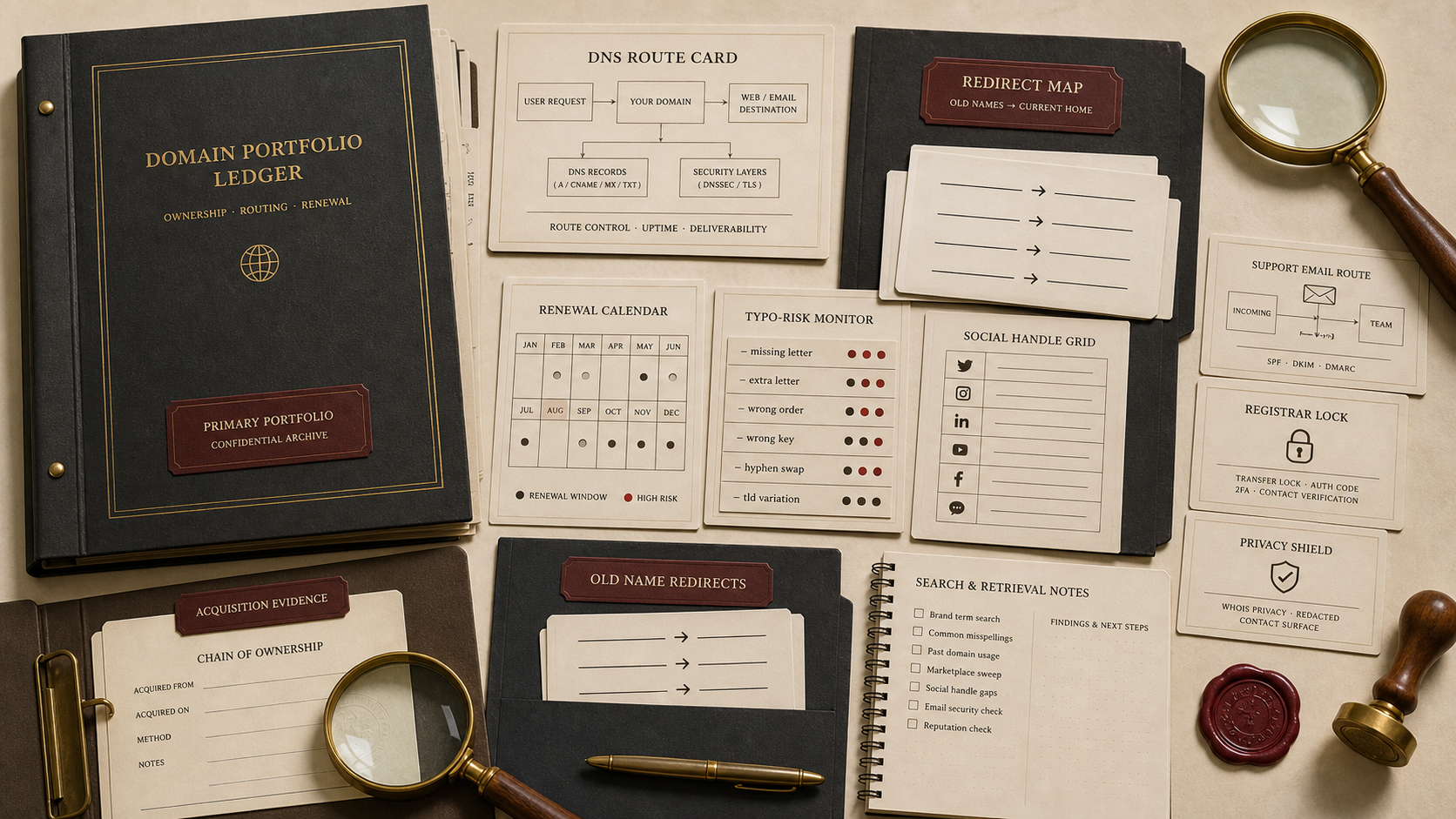
Domain route protection is the practical side of brand protection. It covers the route people use after memory fires: domains, old-name redirects, common typo routes, support email paths, social handles, registrar ownership, renewal calendars, and source records. The upside is trust, continuity, cleaner search memory, and fewer impersonation paths. The downside is ongoing cost, operational ownership, overbuying, renewal failure, and the false belief that owning a domain replaces real brand proof.
Reader payoff
By the end of this page, you should be able to
- Name the proof surface before changing it.
- Separate recognition from preference.
- Use archive cases as a pre-change test.
- Build supporting pages that connect every new brand to a reusable pattern.
Answer Map
Start with the decision, then check the proof.
Quote-ready definition
The Brand Archive definition
"The Brand Archive defines domain route protection as the control of domains, redirects, handles, support routes, old-name routes, renewal ownership, registrar locks, and source records that help people reach the right brand without confusion or impersonation."
Commercial meaning
Why This Matters Commercially
A proof surface matters when it helps the customer act before a full explanation is read.
The same brand can have several proof surfaces: package, name, operating behavior, public memory, search language, support path, or ownership ritual.
Mistake to catch
What Brands Usually Get Wrong
The mistake is treating the visible surface as decoration.
If the market uses the surface to find, trust, repeat, or explain the brand, the surface is part of the brand system.
Competitive gap
What most pages miss
Most pages define the brand concept in general terms.
This page uses cases as evidence. The useful question is which public surface made the brand easier or harder to choose.
Comparison
Route protection map
The route matters because recognition is wasted when the customer cannot reach the right source.
| Route | What it protects | Cases |
|---|---|---|
| Primary domain | The main route from memory to source. | Google, Shopify, Stripe |
| Old-name redirect | Public language during a rename or rebrand. | X / Twitter, Max / HBO Max |
| Support route | Where users go when trust or recovery is at stake. | Zappos, FedEx |
| Platform handle | Social retrieval and impersonation risk. | X / Twitter |
| Commerce route | Checkout, returns, seller identity, and payment trust. | Amazon Prime, Etsy, eBay |
| Renewal and lock | The route stays owned after launch excitement fades. | Operator pattern |
Proof matrix
Domain route protection cases
Each case shows a route to action. The stronger the route, the less memory leaks.
| Case | What happened | What it proves | Operator lesson |
|---|---|---|---|
| X / Twitter Rebrand / 2023 |
Old public language continued to retrieve the brand through search, press, users, and archives. | Old-name route protection matters after a rename. | Keep old-name redirects and public source records visible while the new route earns memory. |
| Max / HBO Max Failure / 2023-2025 |
A removed word still carried category and trust retrieval. | Route names can carry decision value. | Do not shorten a route before measuring what the old word does. |
| Qwikster Failure / 2011 |
The new route made the service split read as harder. | A separate route can expose internal structure. | Keep route ownership aligned with customer behavior. |
| FedEx Trust / 1973-present |
Tracking made the time promise reachable and inspectable. | A status route can become trust proof. | Protect routes customers use when the promise is under pressure. |
| Zappos Trust / 1999-present |
Support, returns, and recovery paths lowered online purchase risk. | The recovery route is part of the brand. | Make support routes easy to find before regret appears. |
| Stripe Brand System / 2010 / 2011-present |
Developer documentation and payment routes made trust practical. | Technical route clarity can carry brand preference. | Own the route where the user verifies the system. |
| Shopify Launch / 2006-present |
Merchant tools and commerce routes formed a repeat operating path. | A platform brand can become the default route to work. | Protect the route users return to every day. |
| Perplexity Launch / 2022-present |
Citation and source routes became part of answer trust. | Verification paths can be brand assets. | Treat source routing as proof, not decoration. |
Route protection is simple to ignore until the brand is known enough for the route to matter.
Decision framework
How to use it
The practical test is whether the concept changes a real decision.
- Name the surface What public-facing surface carries the cue, proof, or risk?
- Name the job Does it help people find, trust, compare, repeat, explain, or recover?
- Name the failure point Where would the customer action slow down if the surface changed?
- Name the bridge Which cue, source, redirect, package, or operating proof keeps old memory usable?
- Name the next case Which future brand would make this pattern stronger?
Questions to consider
Questions to apply before the decision
Use these questions before changing a cue, promise, channel, page, package, or proof point.
- What domain does memory point to first?
- Which old-name routes still need redirects?
- Which handles reduce impersonation risk?
- Who owns renewals, registrar locks, and source records?
- Which support or verification route carries trust under pressure?
Common mistakes
Mistakes to avoid
These mistakes are common because they sound reasonable inside the company and fail when customers meet the brand.
Treating the case as trivia
Extract the customer job the brand surface performed.
Copying the visible asset
Copy the evidence logic, not the look.
Ignoring retrieval
check how buyers, press, search engines, and support teams still find the brand.
Building one-off support pages
Attach each page to a reusable proof surface and case cluster.
Operator test
What to check before spending money
Use the checklist as a pressure test. If the answer is vague, the brand decision is not ready.
- Name the proof surface in plain language.
- List cases that prove the surface can work.
- List cases that prove the surface can fail.
- Add source trails for the strongest claims.
- Link the page to the cases it strengthens.
- Use the pattern again when the next brand is added.
Commercial use
What Another Brand Can Use
Use the page to decide what must be protected before money moves: the name, cue, promise, proof, channel, page, package, or customer habit.
The useful output is not a prettier opinion. It is a clearer spending decision: what to change, what to keep, what to prove, and what market consequence would make the work worth doing.
For private branding work, use the protected contact page.
Source trail
Sources used to check the page claims.
- ICANN: Registering domain names
Source trail for domain registration basics and registrant responsibility.
- USPTO: What is a trademark?
Source trail for marks as source identifiers tied to confusion risk.
- CNNMoney on Qwikster reversal
Source trail for route simplification after the Qwikster split-name plan.
Related Files
Keep the answer inside the archive.
Domain Route Protection FAQ
What is domain route protection?
It is the control of domains, redirects, handles, support routes, renewal ownership, registrar locks, and source records that help people reach the right brand.
Why do domains matter for brand building?
A domain matters when it is the route from memory to action, support, verification, or purchase.
What is the downside of reserving domains and handles?
The downside is ongoing cost, operational ownership, overbuying, renewal failure, and the risk of mistaking route ownership for brand proof.