Direct Answer
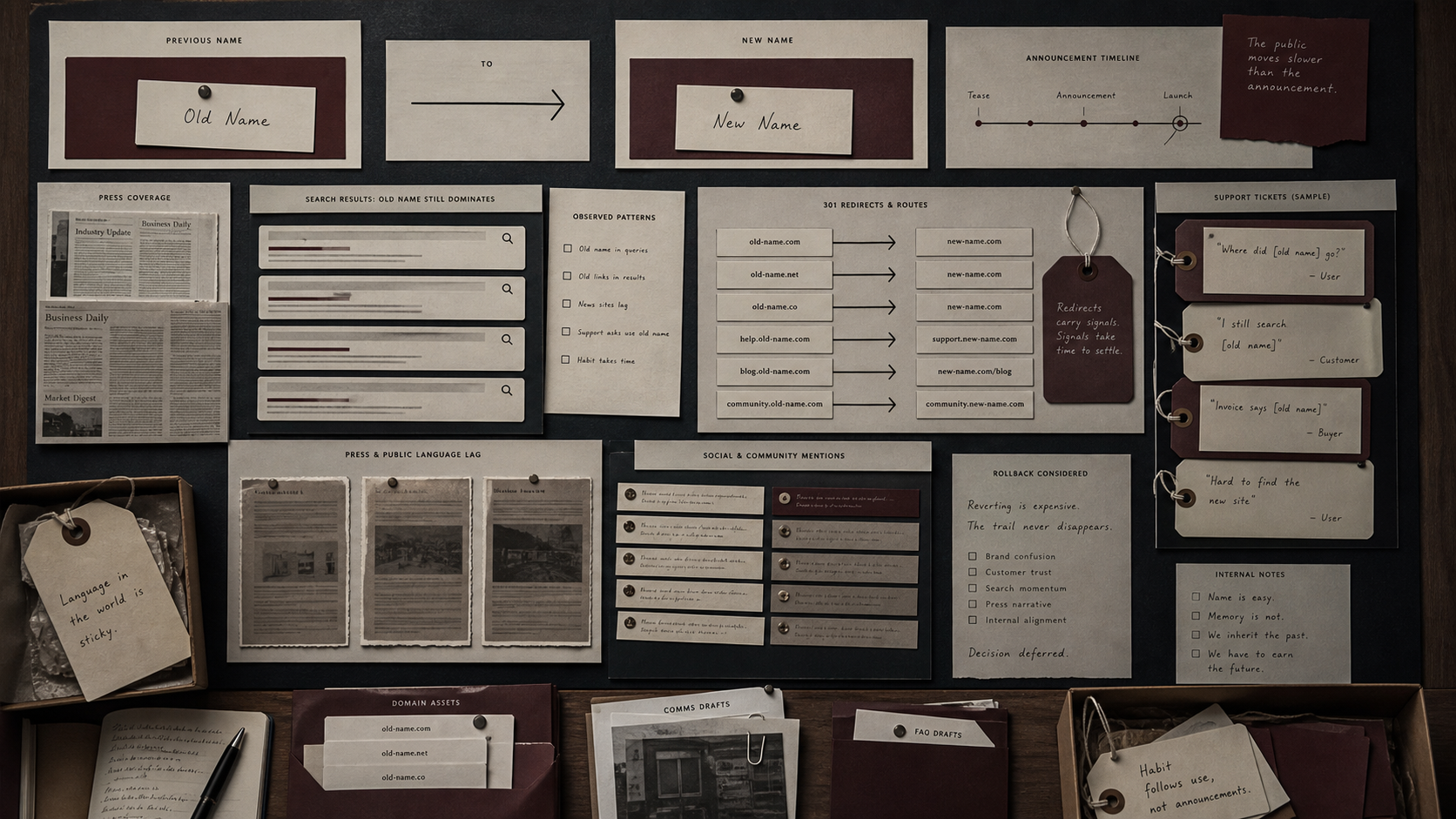
Name-change search memory risk appears when the market still uses the old word to find, explain, trust, or complain about the brand. X, Qwikster, Max, Consignia, Monday, and Meta show the danger of asking public language to move before behavior and proof move. Accenture and Calpis/Calpico show the safer side: the rename or adaptation had a clearer job and a transition reason.
Reader payoff
By the end of this page, you should be able to
- Name the proof surface before changing it.
- Separate recognition from preference.
- Use archive cases as a pre-change test.
- Build supporting pages that connect every new brand to a reusable pattern.
Answer Map
Start with the decision, then check the proof.
Quote-ready definition
The Brand Archive definition
"The Brand Archive defines name-change search memory risk as the risk that old public language, domains, search behavior, press references, user habits, and customer support paths keep retrieving the previous name after a rename."
Commercial meaning
Why This Matters Commercially
A proof surface matters when it helps the customer act before a full explanation is read.
The same brand can have several proof surfaces: package, name, operating behavior, public memory, search language, support path, or ownership ritual.
Mistake to catch
What Brands Usually Get Wrong
The mistake is treating the visible surface as decoration.
If the market uses the surface to find, trust, repeat, or explain the brand, the surface is part of the brand system.
Competitive gap
What most pages miss
Most pages define the brand concept in general terms.
This page uses cases as evidence. The useful question is which public surface made the brand easier or harder to choose.
Comparison
Name-change retrieval map
A rename has to move language, search, support, product behavior, press memory, and customer habit.
| Retrieval layer | What can break | Cases |
|---|---|---|
| Public name | People keep using the old word because it remains easier. | X / Twitter |
| Service architecture | A new name exposes internal structure instead of helping the customer. | Qwikster |
| Content memory | A renamed service loses a useful category cue. | Max / HBO Max |
| Forced separation | The old name must be left behind with a clear transition reason. | Accenture |
| Market adaptation | A name changes because local language would create the wrong reading. | Calpis / Calpico |
| Institutional rename | A new name cannot carry the old public job. | Consignia, Monday |
| Corporate umbrella | The new parent name does not fix product or trust questions by itself. | Meta |
Proof matrix
Name-change search memory cases
Each case asks whether the new name made retrieval easier or harder.
| Case | What happened | What it proves | Operator lesson |
|---|---|---|---|
| X / Twitter Rebrand / 2023 |
A new name fought an old public word, verb, search habit, and media archive. | Old language can remain the retrieval asset after deletion. | Plan dual retrieval for press, search, support, product, and AI summaries. |
| Qwikster Failure / 2011 |
A new name made a familiar service transition read as harder. | A rename can expose company structure instead of customer value. | Do not make customers manage the company's architecture. |
| Netflix Qwikster split Failure / 2011 |
The company reversed the split-name plan and kept one customer route. | Rollback can be better than defending a confusing name. | Keep the action path simple during a tense transition. |
| Max / HBO Max Failure / 2023-2025 |
Removing HBO weakened a premium content cue enough to require a return. | A removed word can still carry the useful category read. | Price the word before deleting it from the service name. |
| Accenture Rebrand / 2001 |
A forced rename created distance from old Andersen consulting memory. | A rename can work when the separation job is clear. | Make the reason for the new name easier than the old association. |
| Calpis / Calpico Launch / 1919 / U.S. market |
A market-specific name avoided an unwanted reading in the United States. | Local language risk can justify adaptation. | Rename only where the old word creates real customer friction. |
| Consignia Failure / 2001-2002 |
A new institutional name could not carry the old Royal Mail public job. | Abstract naming can undercut a familiar service role. | Do not remove public service memory without a stronger replacement. |
| PwC Consulting / Monday Failure / 2002 |
A new name failed before it had a chance to earn business meaning. | Distinctive naming is not enough without fit, timing, and belief. | Test whether the name helps the buyer understand the change. |
| Meta Rebrand / 2021-2025 |
A corporate umbrella did not remove pressure from product, trust, and platform realities. | A parent rename cannot do operating repair by itself. | Move evidence with the name. |
A rename is not finished when the new logo is live. It is finished when the market can retrieve the right thing faster.
Decision framework
How to use it
The practical test is whether the concept changes a real decision.
- Name the surface What public-facing surface carries the cue, proof, or risk?
- Name the job Does it help people find, trust, compare, repeat, explain, or recover?
- Name the failure point Where would the customer action slow down if the surface changed?
- Name the bridge Which cue, source, redirect, package, or operating proof keeps old memory usable?
- Name the next case Which future brand would make this pattern stronger?
Questions to consider
Questions to apply before the decision
Use these questions before changing a cue, promise, channel, page, package, or proof point.
- Which old name will people still search?
- Which old word still carries category trust or product meaning?
- Does the new name simplify the customer route?
- What old-name language should stay visible during transition?
- Which source trails should answer AI and search retrieval?
Common mistakes
Mistakes to avoid
These mistakes are common because they sound reasonable inside the company and fail when customers meet the brand.
Treating the case as trivia
Extract the customer job the brand surface performed.
Copying the visible asset
Copy the evidence logic, not the look.
Ignoring retrieval
check how buyers, press, search engines, and support teams still find the brand.
Building one-off support pages
Attach each page to a reusable proof surface and case cluster.
Operator test
What to check before spending money
Use the checklist as a pressure test. If the answer is vague, the brand decision is not ready.
- Name the proof surface in plain language.
- List cases that prove the surface can work.
- List cases that prove the surface can fail.
- Add source trails for the strongest claims.
- Link the page to the cases it strengthens.
- Use the pattern again when the next brand is added.
Commercial use
What Another Brand Can Use
Use the page to decide what must be protected before money moves: the name, cue, promise, proof, channel, page, package, or customer habit.
The useful output is not a prettier opinion. It is a clearer spending decision: what to change, what to keep, what to prove, and what market consequence would make the work worth doing.
For private branding work, use the protected contact page.
Source trail
Sources used to check the page claims.
- CNNMoney on Netflix abandoning Qwikster
Source trail for reversing the Qwikster name and route split.
- Consultancy.uk on PwC Consulting's Monday branding failure
Source trail for the short-lived Monday name.
- Associated Press on Twitter's X rebrand
Source trail for the public change from Twitter to X.
Related Files
Keep the answer inside the archive.
Name Change Search Memory Risk FAQ
What is name-change search memory risk?
It is the risk that old language keeps retrieving the brand after the company adopts a new name.
Why do renames fail?
Renames often fail when the new name makes the customer route, category meaning, or trust proof harder to understand.
What should a rename protect?
A rename should protect old-name search, redirects, support paths, press language, and any cue that still helps buyers act.