Brand System / Sportswear / football / running / sportstyle / 1948-present
Puma and the Speed Code That Kept a Challenger Sports Brand Moving
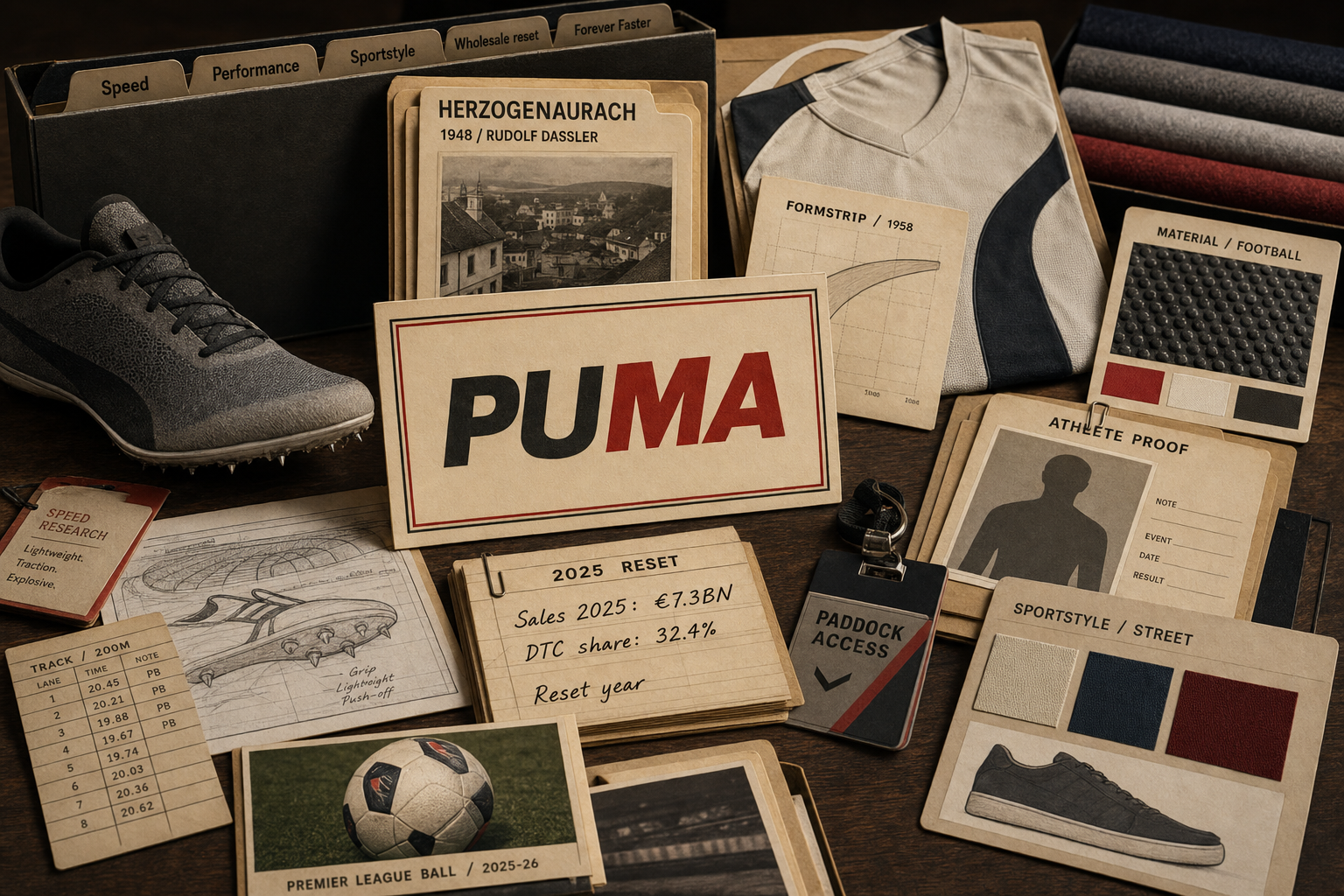
Puma built a challenger sportswear system from Herzogenaurach origin, speed positioning, athlete proof, Formstrip recognition, football boots, running spikes, motorsport, sportstyle, and a 2025 reset.

Short Answer
Puma and the Speed Code That Kept a Challenger Sports Brand Moving is a brand system case about Puma in 1948-present. Puma made speed useful across performance sport and streetwear without losing challenger energy. Challenger sports brands stay legible when one behavior code can travel from product proof to culture. Puma shows how speed can work as a performance cue, a design memory, and a retail reset test.
Key Takeaways
- Puma traces its founding to Rudolf Dassler in Herzogenaurach in 1948.
- Puma's timeline names the Formstrip as a 1958 company mark that moved from footwear function into brand recognition.
- Football, running, motorsport, basketball, and sportstyle give the brand several proof arenas, but speed is the connective behavior.
- Puma reported 2025 sales of EUR 7.3 billion and direct-to-consumer sales equal to 32.4 percent of total sales.
- For operators, the lesson is to keep a challenger code accountable. Speed has to show up in product, distribution, and proof before campaign language can carry it.
The Decision Context
Puma is a useful Germany case because it starts next to a stronger local rival and still builds a global sportswear memory of its own.
The decision problem is familiar for challenger brands. The company needs a code sharp enough to compete in elite sport, flexible enough for streetwear, and measurable enough to survive a reset year.
Rivalry Gave The Brand A Sharp Start
Puma's public timeline places the company in Herzogenaurach in 1948 under Rudolf Dassler. That origin matters because the brand was born inside a town and category already dense with sportswear rivalry.
The archive value is the challenger pressure. Puma could not rely on being the default. It had to make its proof visible, repeatable, and quick to read.
The Formstrip Made Movement Visible
Puma's timeline identifies the Formstrip as a 1958 mark. It began with footwear function and became a repeatable visual memory across shoes and sport surfaces.
That is stronger than decoration. A movement-shaped code helps the product look fast before the customer reads any copy.
Athlete Proof Kept Speed Credible
Speed language collapses when it is separated from proof. Puma kept feeding the idea through track, football, motorsport, basketball, and visible athlete moments.
The brand lesson is simple: a challenger can own a behavior only when the market sees that behavior being tested.
Football And Running Kept The Product Grounded
Puma's football and running systems keep the brand close to performance decisions: grip, touch, traction, fit, weight, energy return, and visibility at speed.
The Premier League ball partnership from the 2025/26 season adds a mass-viewing surface to that performance story. It puts the brand into the match object as well as the kit and sideline.
Sportstyle Let The Code Travel
The sportstyle layer works because it borrows from the performance layer. Sneakers, motorsport references, and streetwear collaborations make speed wearable away from competition.
That travel is useful only when the code stays clear. Puma's challenge is to let culture extend the brand without making performance feel like background history.
The 2025 Reset Raised The Proof Burden
Puma's 2025 annual report frames the year as a reset, with sales at EUR 7.3 billion and direct-to-consumer sales at 32.4 percent of total sales.
That matters for brand analysis because reset years test whether positioning is operational. If the brand says speed, the product range, wholesale choices, retail experience, and full-price discipline have to move together.
The Archive Reading
Puma belongs in the balanced Germany sprint because it adds a challenger sportswear case after Adidas without pretending the whole archive should become a country checklist.
For operators, the lesson is to choose a code the business can keep proving. A good challenger idea has to travel through product, proof, culture, and commercial discipline.
Comparable Cases
Sources

People Also Ask
What happened to Puma?
Puma and the Speed Code That Kept a Challenger Sports Brand Moving is a brand system case about Puma in 1948-present. Puma made speed useful across performance sport and streetwear without losing challenger energy. Challenger sports brands stay legible when one behavior code can travel from product proof to culture. Puma shows how speed can work as a performance cue, a design memory, and a retail reset test.
Why is Puma a brand system case?
Puma is filed as a brand system case because the visible consequence sits in that decision pattern. Puma made speed useful across performance sport and streetwear without losing challenger energy.
What can brands learn from Puma?
Challenger sports brands stay legible when one behavior code can travel from product proof to culture. Puma shows how speed can work as a performance cue, a design memory, and a retail reset test.
Is Puma still operating?
The Brand Archive marks Puma as Active / continuing. That means the brand, company, platform, product system, or parent organization is still operating, continuing, or being actively resolved.
What should Puma be compared with?
Compare Puma with Adidas, Nike, Li-Ning to see the same decision pattern from nearby cases.