Brand System / Sportswear / culture / 1949-present
Adidas Three Stripes Brand System Case
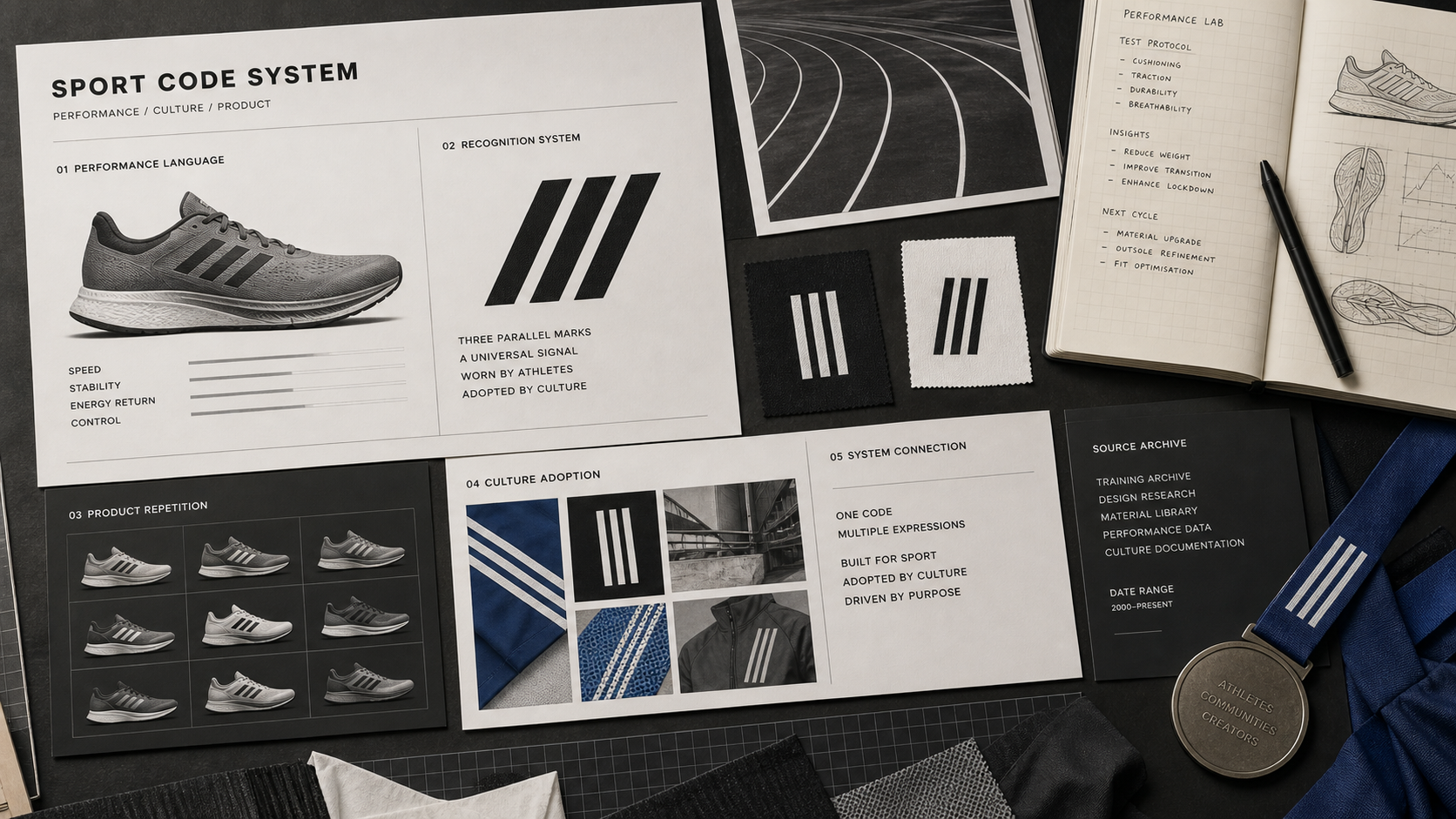
Adidas turned a simple sport code into a global system by linking performance footwear, team kits, athlete proof, street culture, material repetition, and product recognition.

Short Answer
Adidas Three Stripes Brand System Case is a brand system case about Adidas in 1949-present. Adidas turned three stripes from a footwear marking into a repeatable product, kit, and culture cue. Recognition systems scale when the same cue stays useful on equipment, teamwear, retail shelves, athlete proof, and street use without losing its performance origin.
Reader Task
What this entry should help you finish
Use this entry to finish four jobs: answer what happened to Adidas, see why it belongs in the brand system lane, inspect the decision consequence, and leave with the operator lesson. The point is not to remember the brand. The point is to know what decision, proof surface, or failure mode a team should check next. Then compare it with Nike, Puma, UNIQLO before turning the case into a rule.
What Adidas teaches
- Adidas connects performance footwear, team sport, athlete proof, product repetition, and street culture.
- The three-stripe memory works because it is simple enough to repeat across surfaces.
- The brand stays strong when culture adoption still points back to sport credibility.
- Product codes become more valuable when they can travel across categories without explanation.
- The decision lesson is to protect the proof behind the cue. If the stripe, swoosh, color, or shape stops pointing to a product habit, it becomes decoration.
Why This Brand Belongs In Grow Your Brand
Adidas belongs in Grow Your Brand because the page studies a specific brand decision, not a company profile. The decision sits in brand system and gives operators a way to see how operating layer changes commercial value.
The useful archive question is what changed in recognition, trust, demand, pricing power, category position, or public memory after the market saw the move.
The Brand Asset At Stake
The asset at stake is daily usage, uptime, distribution, account trust, partner tools, switching cost, and recovery when the service fails. That asset matters because it affects how people find, understand, choose, trust, or repeat the brand when the company is not in the room to explain itself.
For Adidas, the asset is not abstract equity. It has to show up in the buying surface, product surface, service route, source record, or repeated customer behavior.
What Changed
Adidas turned three stripes from a footwear marking into a repeatable product, kit, and culture cue.
The change forced the market to decide whether the old shortcut still worked, whether the new proof was strong enough, and whether the brand had made the category easier or harder to understand.
What The Market Learned
The market learned to judge Adidas through the gap between the visible move and the proof behind it. talking about scale, innovation, or ecosystem reach while hiding the exact behavior people repeat is the weak reading this page is meant to prevent.
A useful brand decision makes buying, remembering, trusting, or repeating easier. A weak decision makes the audience do more work before it believes the claim.
Commercial Consequence
The commercial consequence sits in operating layer: daily usage, uptime, distribution, account trust, partner tools, switching cost, and recovery when the service fails. When that proof becomes easier to see, customers have more reason to choose, trust, repeat, or pay attention. When it becomes harder to see, the brand has to spend more money explaining what the market used to understand faster.
Adidas matters because the decision changed more than presentation. It changed buyer confidence, memory, category position, or repeat behavior in sportswear / culture. That is why the case belongs in a brand decision library instead of a general company profile.
What Another Brand Should Learn
Another brand should use this case before spending money on a similar move. Name the customer behavior, the proof surface, the protected cue, and the consequence that would make the decision worth the cost.
If the same proof does not exist in the business, copying Adidas would copy the surface while missing the reason the decision mattered.
The Decision Context
Sportswear brands have a recognition problem that most categories never face. The cue has to work while a player is moving, while a shoe is half-visible, while a sleeve passes on screen, and while a product sits beside similar rivals in a store.
Adidas solved that problem with repetition rather than explanation. The three stripes became a field mark, a product mark, a retail mark, and later a culture mark. The strategy only works because the cue is easy to recognize before the buyer has time to read.
The Code Had To Work At Speed
Adidas says the company was registered in 1949 and that a shoe with the soon-famous 3-Stripes was registered the same year. That matters because the cue began as a product-side marking, not as a late lifestyle graphic.
The early proof was not brand theory. It was sport use: football boots, athlete feedback, team kits, tracksuits, match balls, and shoes that carried the same visual rhythm into different sports. A buyer could see the same code while watching the game and while choosing the product.
Culture Worked Because Sport Stayed Visible
The weak reading of Adidas is that the stripes became cool because fashion adopted them. That skips the harder part. Street culture could borrow the mark because the mark already had sports credibility, product history, and enough physical repetition to be recognized without a paragraph of explanation.
Samba, Superstar, Stan Smith, teamwear, and football lines give the code several entry points. The brand is not asking one campaign to do all the memory work. It lets products, categories, and use contexts keep refreshing the same signal.
Where The Strategy Can Break
A portable code can become too available. If every surface carries the cue but too few surfaces carry performance proof, the mark starts to act like styling instead of evidence.
That is the risk for any brand copying Adidas. A visible stripe, color, patch, or symbol does not create authority by itself. It needs a use case, a product habit, and a reason the buyer sees it as more than a decoration.
The Bad Example
The bad copycat launches a simple mark, repeats it everywhere, and calls the repetition a brand system. Then the product line, sponsorships, store language, and customer behavior fail to teach the same meaning.
The result is recognition without consequence. People may notice the cue, but they cannot say what risk it reduces, what product behavior it promises, or why it should matter at the buying moment.
What To Copy
Copy the constraint, not the stripe. Adidas had a cue that could survive motion, cropping, different product shapes, and different levels of attention. That is the useful design problem for another brand.
A team copying the discipline would ask four questions before drawing anything: where will the cue appear at speed, what product behavior will make it believable, which category moments will repeat it, and what customer memory should remain when the logo is gone.
The Decision Limit
The Adidas comparison breaks when the new brand has no repeated use surface. A cue cannot become a system if customers see it once in a launch campaign and then rarely meet it again in the product, service, packaging, or community.
The test is simple. Remove the brand name and ask whether the remaining cue still helps someone identify the category, use, promise, or risk. If the answer is no, the system is too dependent on explanation.
The Signal Reading
Adidas is useful because it turns recognition into an operating question. The case is about whether a brand can keep one cue meaningful across sport proof, product families, retail, sponsorship, and culture.
The lesson is to make the smallest useful code repeatable, then keep attaching it to proof. A mark becomes strategic when many contexts point back to the same promise instead of scattering into disconnected style.
Compare Next
Related Cases
Do not read Adidas alone. Compare it against nearby cases: Nike, Puma, UNIQLO.
Sources

People Also Ask
What happened to Adidas?
Adidas Three Stripes Brand System Case is a brand system case about Adidas in 1949-present. Adidas turned three stripes from a footwear marking into a repeatable product, kit, and culture cue. Recognition systems scale when the same cue stays useful on equipment, teamwear, retail shelves, athlete proof, and street use without losing its performance origin.
Why is Adidas a brand system case?
Adidas is filed as a brand system case because the visible consequence sits in that decision pattern. Adidas turned three stripes from a footwear marking into a repeatable product, kit, and culture cue.
What can brands learn from Adidas?
Recognition systems scale when the same cue stays useful on equipment, teamwear, retail shelves, athlete proof, and street use without losing its performance origin.
Is Adidas still operating?
Grow Your Brand marks Adidas as Active / continuing. That means the brand, company, platform, product system, or parent organization is still operating, continuing, or being actively resolved.
What should Adidas be compared with?
Compare Adidas with Nike, Puma, UNIQLO to see the same decision pattern from nearby cases.