Short Answer
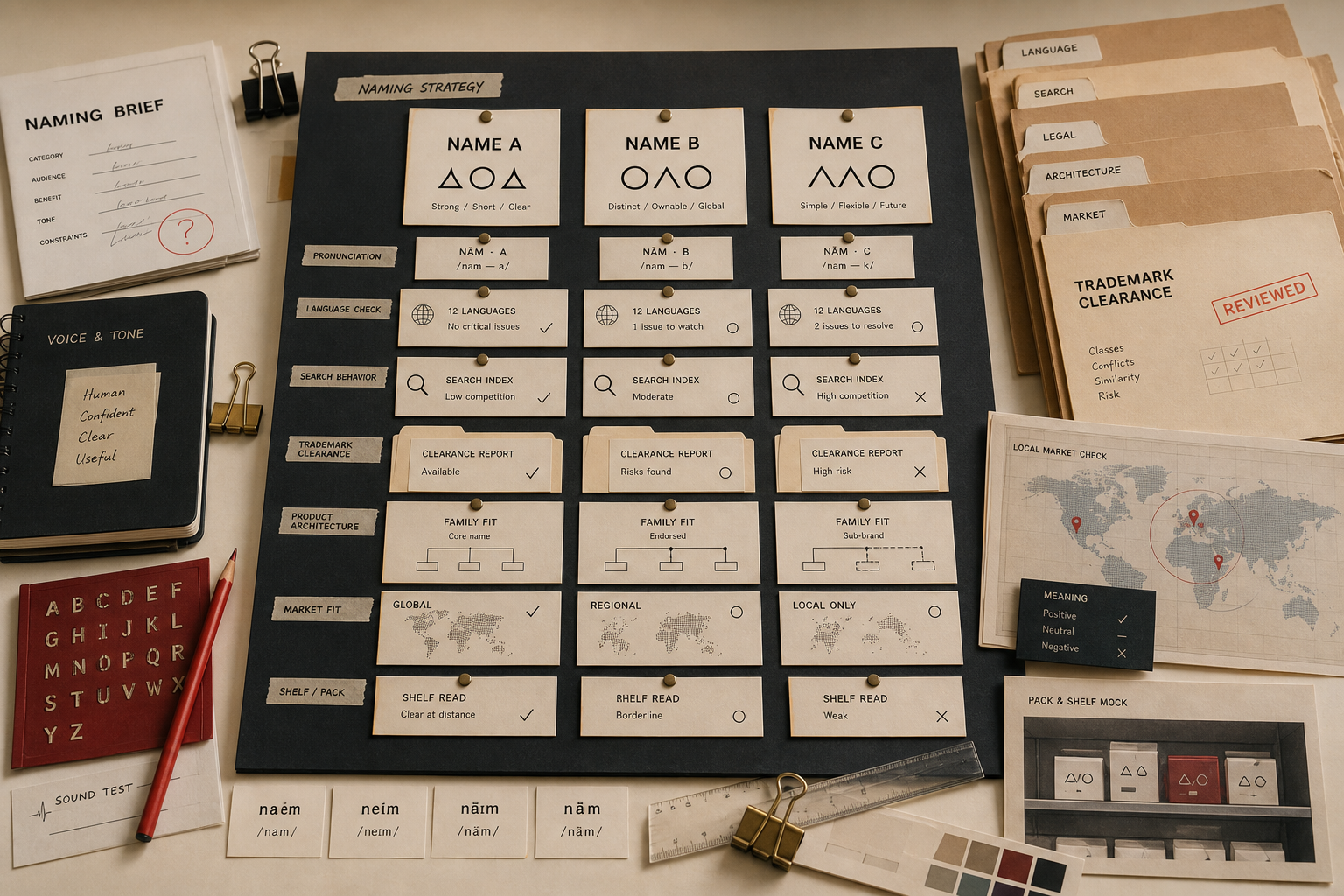
Brand naming is a customer workload problem. A useful name is easy to say, search, remember, recommend, support, and place inside the right product family.
Naming Map
Test names where people use them.
Theory
A name has to work after the meeting ends.
Teams choose names in rooms. Customers use them in speech, search, shelf scanning, invoices, support calls, store maps, product menus, and memory.
The useful question is simple: what work does this name remove for the customer?
A name can create confidence when it gives the market a short handle for the thing it already wants to understand. It can also create drag when it asks people to decode internal structure, pronunciation, category, or strategic ambition.
Good naming is often quiet. The best decision may be a local adaptation, a clearer product line, a bridge from an old name, or the refusal to rename something the market already knows how to use.
How To Choose
Test the name where customers will use it.
A naming deck hides most of the risk. Real surfaces expose it fast.
Run the name through speech, spelling, search, local language, packaging, support, and architecture before the launch makes the choice expensive.
01
Start with speech.
If customers cannot say the name cleanly, they will avoid it, shorten it, misremember it, or turn it into the wrong joke. Speech is the first market test.
02
Test search before the launch.
A name has to be found by real people under imperfect conditions. Confusing spelling, similar terms, unclear category cues, and old language all tax the customer.
03
Set architecture before choosing the word.
The name has to fit the product family, parent brand, regions, future lines, and customer support scripts. A good word can still fail inside the wrong architecture.
Decision Patterns
Different naming jobs need different rules.
A local-market fix, a parent-company rename, a product-line name, and a portfolio umbrella do different work.
Judge the name by the burden it carries, not by how clever it sounds alone.
01
Use local adaptation when the global name creates friction.
One global name is clean on a chart. It can still be wrong in a market where speech, slang, or shelf reading changes the meaning.
02
Rename only with a bridge.
A new name needs old recognition to cross over. Bridge language, redirects, launch proof, sales scripts, and repeated usage do the work the announcement cannot do.
03
Use product names to reduce the decision.
A product name should tell buyers where the thing belongs. If the name makes the customer ask whether it is a version, accessory, platform, or replacement, the launch starts with drag.
Bad Decisions
Names fail when they make customers decode the company.
The organization may understand the strategy behind a name. The market meets the name cold.
If the name creates extra explanation, the brand has to pay that tax on every surface.
01
The name mirrors the org chart.
Customers do not want a tour of internal structure. A name that explains the company plan can still make the buying relationship harder.
02
The name passes legal review and fails the mouth.
Legal clearance is one gate. Speech, jokes, spelling, scripts, search, and recommendation are separate gates.
03
The new name deletes a useful public word.
If people already use the old name as a verb, shortcut, or category handle, the new name has to earn that behavior again.
Brand Naming FAQ
What makes a good brand name?
A good brand name makes a useful customer action easier. People should be able to say it, search it, remember it, recommend it, and place it inside the right category.
When should a company rename?
Rename when the current name blocks the strategy, creates legal or language risk, limits the architecture, or carries reputation damage the business can no longer repair through behavior alone.
Should every market use the same name?
Use one global name when speech, search, meaning, and category reading survive across markets. Use local adaptation when consistency would create avoidable friction.
What is naming architecture?
Naming architecture is the rule for how parent brands, product lines, features, tiers, regions, and campaigns are named so customers can understand the system without decoding the company.
What is the fastest naming test?
Say the name out loud, spell it once, search it, place it on a shelf label, put it inside a support sentence, and ask what joke or confusion appears first.