Short Answer
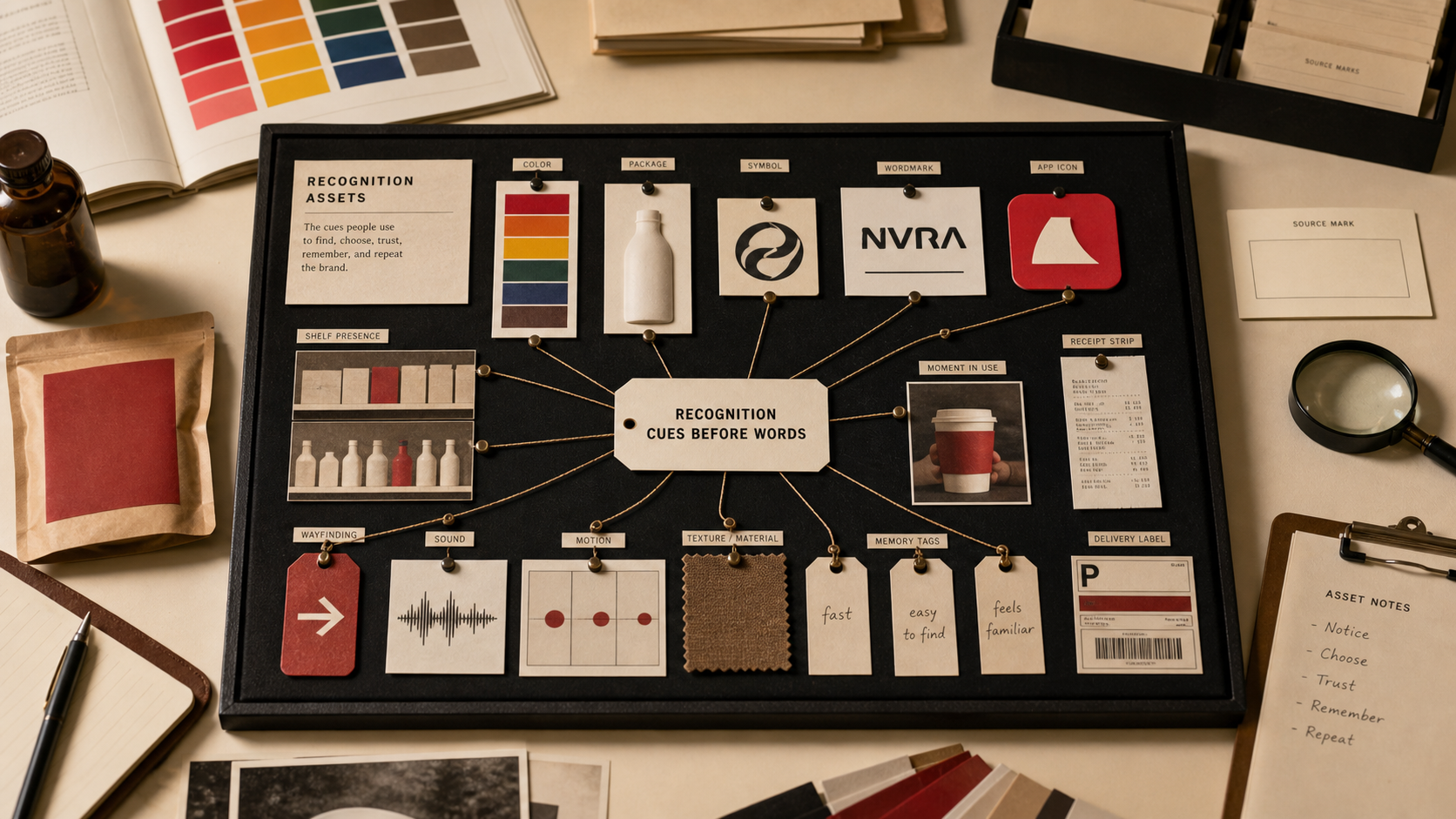
Brand recognition assets are the cues people use when they are too busy to read: color, shape, mark, package, sound, product form, store cue, app tile, uniform, ritual, or language. Protect the cue before changing the design.
Recognition Map
Find what customers remember before they read.
Theory
Recognition happens before explanation.
Customers often decide from memory under weak attention. They scan a shelf, pass a sign, open an app grid, handle a package, see a receipt, or notice a vehicle in motion.
The cue they use first is the asset. It may be the color, mark, word, shape, material, sound, product silhouette, store ritual, or repeated service surface.
A brand team may see a complete identity system. The market usually sees fragments. One color block, one package shape, one sound, one icon, one uniform, or one phrase can do more recognition work than the full guideline file.
That is why recognition assets need a separate audit before any redesign. The question is not whether the asset looks modern. The question is whether customers still use it to find, choose, trust, or repeat the brand.
How To Audit
Test the cue where recognition actually happens.
A recognition asset is measured in the customer moment, not in the brand deck.
Put the cue in the real environment, remove the company name when useful, place it beside competitors, then watch what people identify first.
01
Find the cue customers use first.
Look for the thing people recognize before they read: color, shape, package, mark, store cue, product form, app tile, sound, gesture, uniform, or repeated phrase.
02
Test the cue under weak attention.
Recognition assets have to work when people are moving, scanning, distracted, tired, or using a small screen. If the cue needs a perfect brand deck, it is too fragile.
03
Separate owned memory from borrowed style.
A trend can make a brand look current. A recognition asset makes the brand easier to find again. The audit has to separate market memory from decorative taste.
Decision Patterns
Different assets carry different kinds of memory.
Package shape, color, wordless marks, store cues, service surfaces, sounds, and rituals are not interchangeable.
Each one has to be judged by the place where customers meet it and the action it makes easier.
01
Protect package and product shape when shelf memory matters.
For packaged goods, the useful asset may be the silhouette, cap, label block, wrapper, material, or shelf rhythm. Change it only after you know what people use to find the product.
02
Protect marks that work without words.
A wordless mark is useful only after customers know what to attach to it. When that memory exists, the mark can move faster than language.
03
Protect service cues that help people find the system.
Delivery, retail, travel, finance, and support brands often depend on cues that appear in the field: vehicles, uniforms, counters, signs, cards, receipts, or account screens.
Bad Decisions
Most damage comes from removing a shortcut.
A redesign can make the system cleaner and the brand harder to find.
If the old cue still carries memory, the new system has to train a replacement before the old asset disappears.
01
The redesign cleans away the cue.
A team can make a system look simpler and still make it harder to recognize. The first audit question is what the old design was doing for the customer.
02
The company changes the cue before training a replacement.
A familiar cue can be replaced, but the bridge has to be deliberate. New assets need repetition, explanation, and proof before the old shortcut disappears.
03
The brand treats legal control as customer memory.
Trademark protection and customer recognition are different tests. A cue may be legally protectable and still weak, or culturally powerful and hard to control.
Brand Recognition Assets FAQ
What is a brand recognition asset?
A brand recognition asset is any cue people use to identify the brand before they read or think deeply: color, shape, mark, package, sound, product form, store cue, app tile, uniform, or ritual.
Can a color be a recognition asset?
Yes, when customers repeatedly meet that color in the same brand moment. Color alone is weak. Color attached to a package, store, vehicle, app, ritual, or service behavior can become strong.
When should a company protect a recognition asset?
Protect it when customers use it to find, trust, buy, open, choose, or repeat the brand. Change is safer when the cue is weak, misleading, or already replaced by a stronger asset.
What is the fastest recognition asset test?
Show the brand at small size, at distance, in motion, beside competitors, without the name, and inside the real surface. Watch which cue people use first.
What is the biggest recognition asset mistake?
The biggest mistake is cleaning away the old cue before the new system has earned memory. The redesign may look better and still make the brand harder to find.