Short Answer
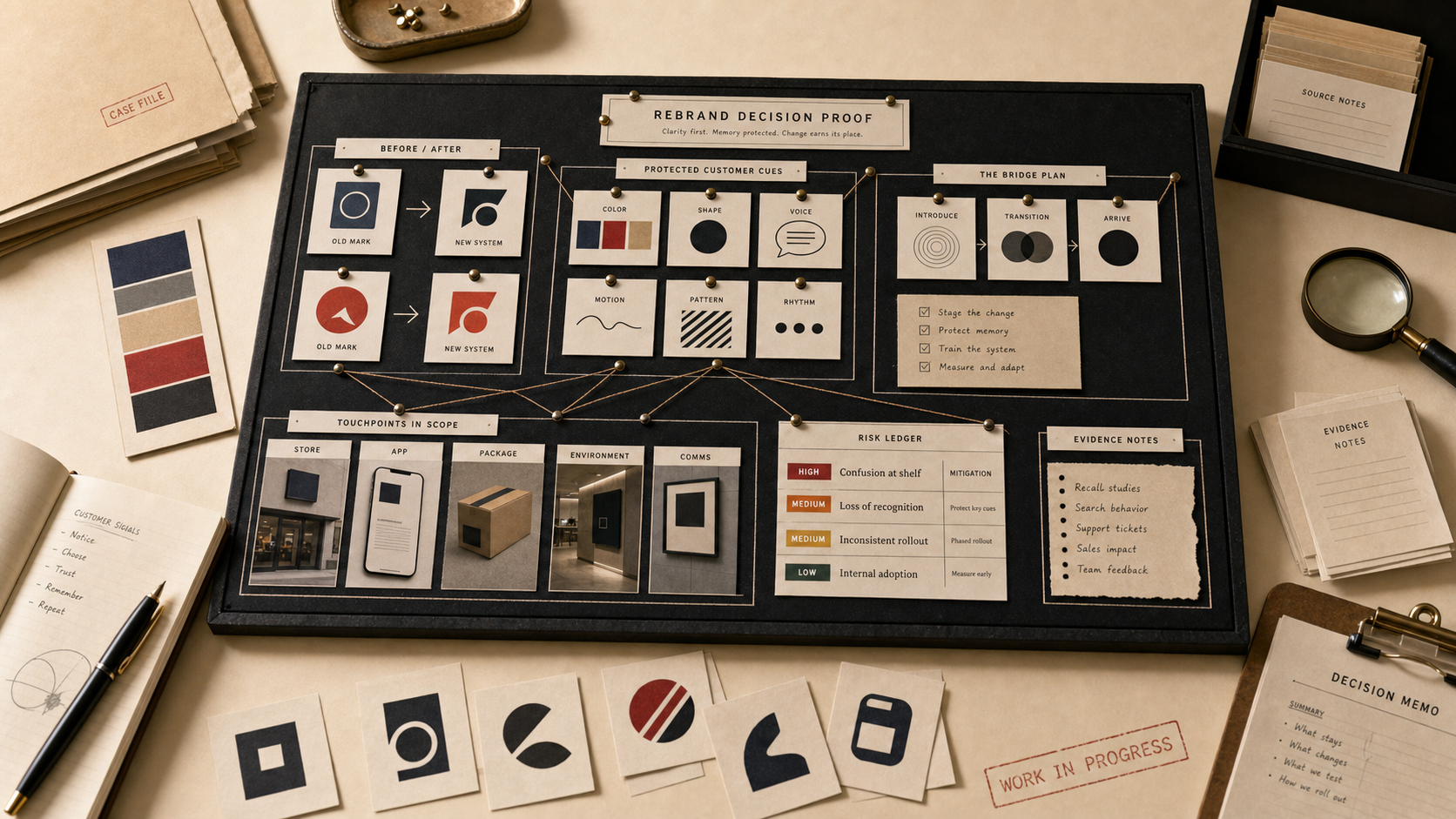
A rebrand is a memory-risk decision. Change the system only after you know which cues customers still use, what the new system must prove, and how the rollout will train recognition.
Rebrand Map
Change the system without breaking customer memory.
Theory
A rebrand changes the customer's shortcut.
A company sees a new identity system. Customers see a broken shortcut if the change removes the cue they used to find, trust, or repeat the brand.
The question is not whether the old design feels dated. The question is whether the old cue still does useful work.
Good rebrands are not cosmetic apologies. They name a real business change, protect the memory worth keeping, and train the market before asking for a new reading.
Bad rebrands make customers do extra work. The company may get a cleaner mark, a sharper deck, or a future-facing story. The market gets confusion, lost recognition, or a claim the business has not earned yet.
How To Rebrand
Audit memory before approving change.
A rebrand should begin with the customer surfaces, not the design options.
Find the cue, measure the risk, decide the bridge, then train the new system in public.
01
Write the customer memory inventory first.
Before choosing a new system, list the cues people already use: name, color, mark, package shape, sound, store signal, product form, app tile, support language, or route habit.
02
Separate what changes from what trains the change.
A new logo, name, type system, or package needs a bridge. Customers need repetition, context, rollout discipline, and proof before the old shortcut disappears.
03
Test the rebrand outside the launch deck.
Put the new system on the small, boring, public surfaces: receipts, app icons, shelves, signs, invoices, email headers, support scripts, uniforms, and search results.
Decision Patterns
Not every rebrand is the same kind of change.
A rename, a logo simplification, a package change, a parent-company move, and a category pivot carry different risks.
Judge the rebrand by what customer behavior has to change after launch.
01
Modernize when the old system blocks the truth.
A rebrand can help when the current identity misstates the offer, traps the company in an old category, or hides proof the business now has.
02
Simplify only after recognition is earned.
A wordless mark, reduced package, or lighter type system works when the market already knows what to attach to it.
03
Use rebranding to govern architecture, not just style.
The hard work is often naming, product structure, endorsements, regions, support language, and customer pathways. A new visual system will not repair confused architecture by itself.
Bad Decisions
Most rebrand damage comes from adding work.
Customers do not owe the company a second explanation.
If the new system makes the brand harder to recognize, pronounce, search, buy, or believe, the launch has created drag.
01
The team confuses cleaner with clearer.
A cleaner identity can still be harder to find, say, recognize, or trust. Clarity belongs to the customer, not the brand deck.
02
The new name adds a second problem.
A rename can solve one issue and create another if it adds pronunciation, search, explanation, or category confusion.
03
The business has not changed enough.
A rebrand raises the proof burden. If the customer meets the same broken service, product, or category problem underneath the new surface, the change becomes evidence against the company.
Brand Rebrands FAQ
What is a rebrand?
A rebrand is a change to how a company is recognized and understood. It can include name, mark, color, type, package, voice, architecture, product cues, and rollout behavior.
When should a company rebrand?
Rebrand when the current system blocks the truth, creates risk, limits growth, confuses customers, or no longer matches the business. Do not rebrand only because the design feels old.
What should not change in a rebrand?
Do not casually change the cues customers still use to find, trust, buy, open, remember, or recommend the brand. Protect the asset until a replacement has earned memory.
What is the fastest rebrand risk test?
Show the new identity without explanation on the real surfaces: shelf, sign, app tile, search result, invoice, package, receipt, uniform, and support email. Ask what people recognize first.
Why do rebrands fail?
They fail when the company removes useful memory, adds customer work, overclaims business change, or treats a launch deck as proof that the market has learned the new system.