Failure / Ride hailing / Mobility platform / 2016-2018
Uber and the App Icon That Made Recognition Harder
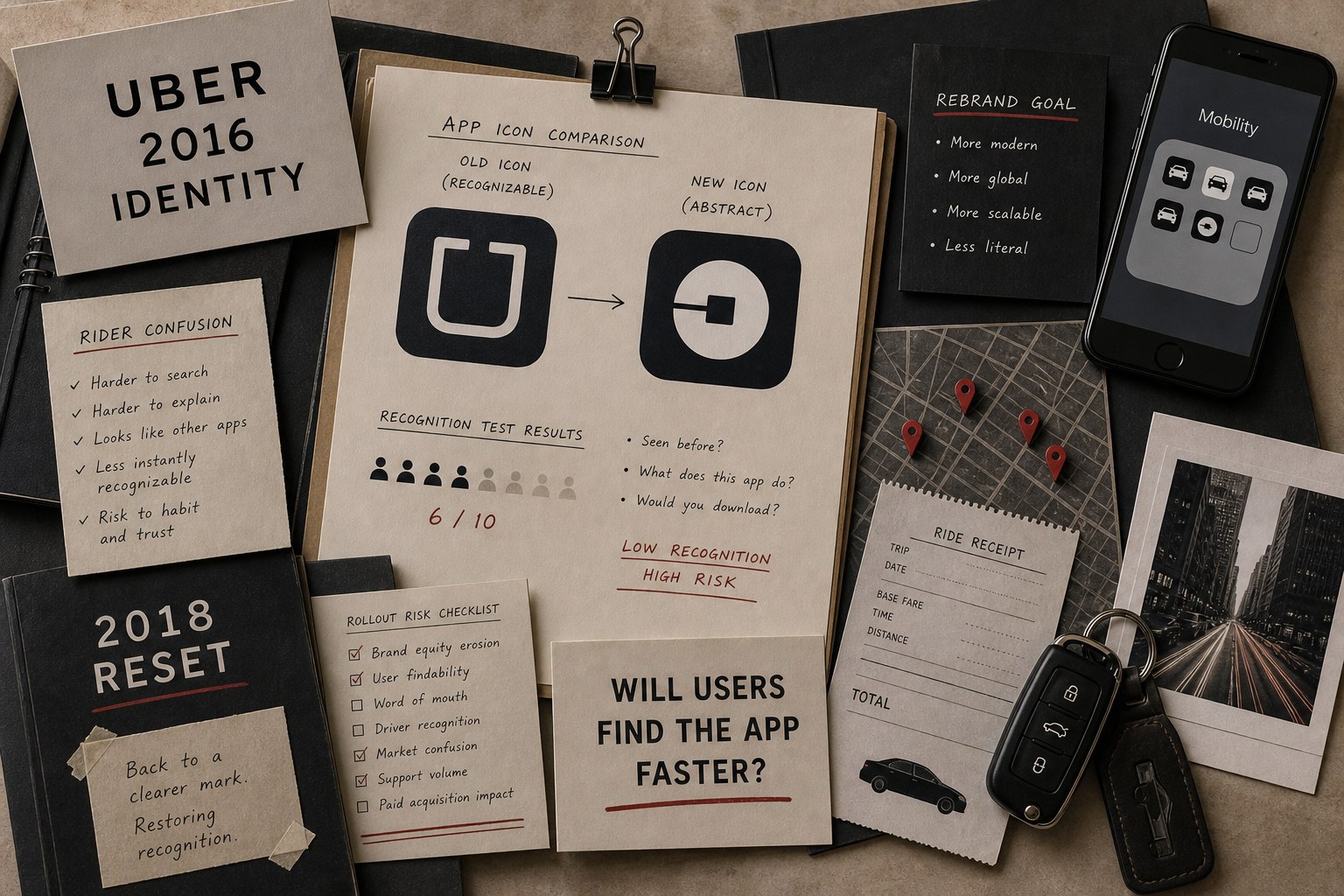
Uber's 2016 identity change is a warning for any rebrand proposal that treats a small app icon as a design surface instead of a live customer-finding cue.

Short Answer
Uber and the App Icon That Made Recognition Harder is a failure case about Uber in 2016-2018. A ride-hailing app made its finding cue more abstract, then later moved back toward a clearer brand system. App icons are not mood boards. They are customer wayfinding. A rebrand proposal has to prove the new cue works at thumb speed, small size, and under stress.
Key Takeaways
- Uber introduced a major identity change in 2016, including a new app icon system.
- The redesign drew criticism and confusion because the app cue became more abstract.
- Uber introduced another brand system in 2018 with clearer wordmark and app recognition logic.
- The buyer question is whether the new identity makes the product easier to find, use, and trust.
- The decision route is agency proposal review: test the identity where customers actually meet it, not only in presentation frames.
The Decision Context
Uber was already a behavior: open the phone, find the app, request a ride, watch the car move. Recognition was tied to speed.
The 2016 redesign put more symbolic weight on a new abstract system. That may have made sense inside the brand theory, but the customer still had one practical job: find the app fast.
What Broke
A ride-hailing icon has very little time to explain itself. If the mark asks the rider to stop and decode it, the design is creating friction at the exact moment the user wants motion.
That is why the 2018 reset is part of the case. It suggests the brand needed a clearer public cue after the abstract icon had carried too much explanation burden.
The Buyer Question
Before approving a rebrand proposal, ask whether the new mark helps the buyer act faster on the most common surface.
The right test is practical: phone screen, dark mode, airport stress, small size, competitor row, old customer memory, and support scripts. If recognition slows down, the redesign is still unfinished.
The Archive Reading
Uber belongs in this failure set because it shows how a sophisticated identity can still miss the usage surface. The new cue needed to work for riders before it worked for brand theory.
For operators, the lesson is to treat every high-frequency symbol as infrastructure. The more often customers use it, the less room the mark has to become obscure.
Comparable Cases
Sources

People Also Ask
What happened to Uber?
Uber and the App Icon That Made Recognition Harder is a failure case about Uber in 2016-2018. A ride-hailing app made its finding cue more abstract, then later moved back toward a clearer brand system. App icons are not mood boards. They are customer wayfinding. A rebrand proposal has to prove the new cue works at thumb speed, small size, and under stress.
Why is Uber a failure case?
Uber is filed as a failure case because the visible consequence sits in that decision pattern. A ride-hailing app made its finding cue more abstract, then later moved back toward a clearer brand system.
What can brands learn from Uber?
App icons are not mood boards. They are customer wayfinding. A rebrand proposal has to prove the new cue works at thumb speed, small size, and under stress.
Is Uber still operating?
The Brand Archive marks Uber as Active / continuing. That means the brand, company, platform, product system, or parent organization is still operating, continuing, or being actively resolved.
What should Uber be compared with?
Compare Uber with Instagram, Kia, Gap to see the same decision pattern from nearby cases.