Direct Answer
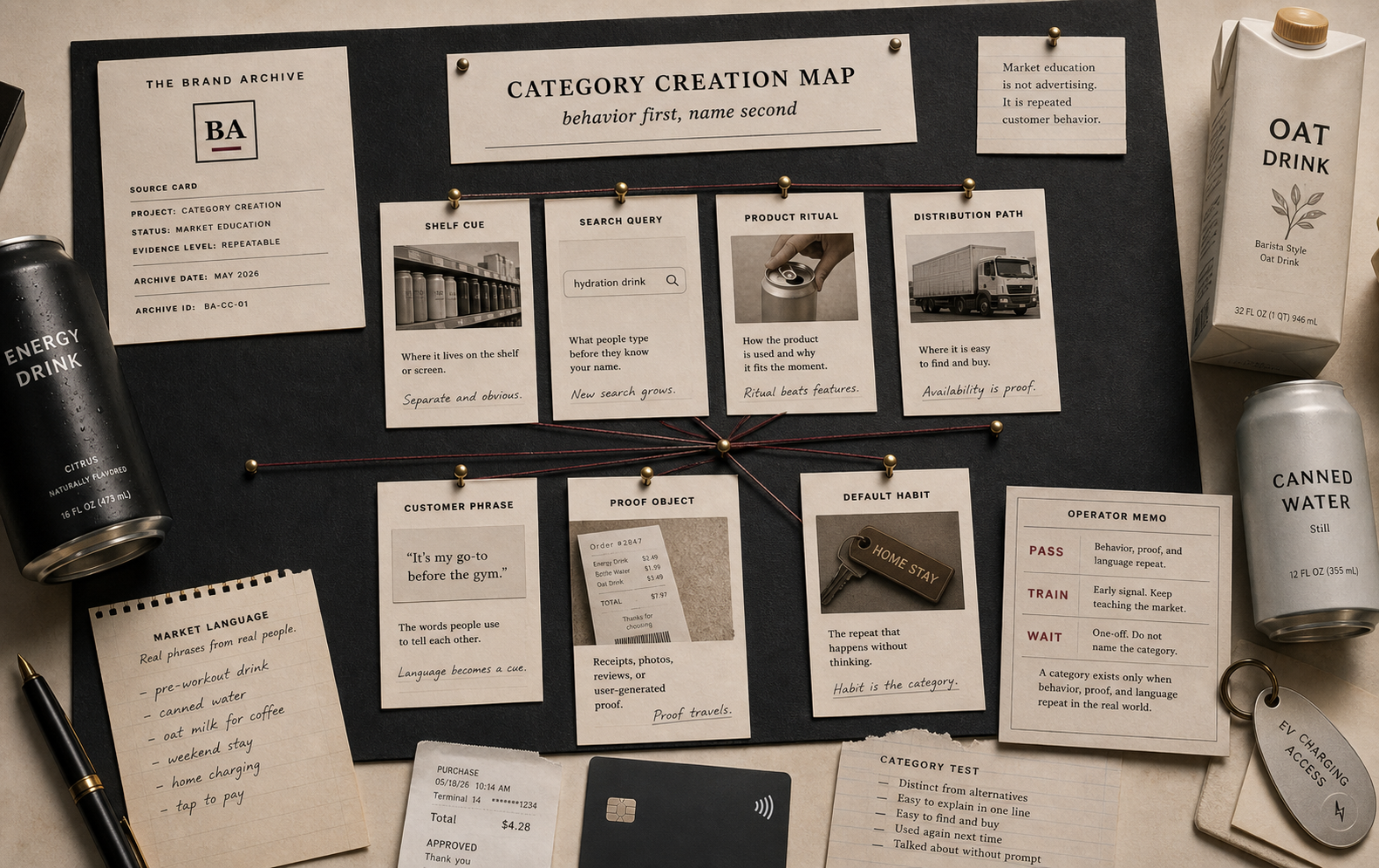
Category creation is not naming theater. Liquid Death changed the comparison for water. Oatly made oat drink easier to ask for. Red Bull made energy visible through use occasions and media. Uber and Airbnb taught new behaviors by making the old comparison feel less useful.
Answer Map
Read the answer, then inspect the proof.
Quote-ready definition
The Brand Archive definition
"The Brand Archive defines category creation brand strategy as a strategy that teaches customers a new choice frame through repeated behavior, category language, use cases, proof, distribution, and comparison."
Why it matters
Why it matters
A category becomes real only when customers repeat behavior. They have to know when to search, when to buy, what to compare, and what words to use.
Common mistake
What people get wrong
The mistake is launching a category name before the market has a repeated behavior. A phrase on a pitch deck is not a category.
Competitive gap
What most pages miss
Most category creation pages celebrate naming. This page asks what behavior the brand trained, what old comparison it displaced, and what proof made repeat use possible.
Comparison
Category creation proof
The useful question is what behavior the brand trained.
| Category move | Behavior trained | Archive cases |
|---|---|---|
| Contrast | Use familiar cues from another category to change the read. | Liquid Death, Oatly |
| Occasion | Teach when the product belongs. | Red Bull, Nespresso |
| Access route | Make a new behavior easy enough to repeat. | Uber, Airbnb |
| Demand frame | Make the old substitute feel incomplete. | Tesla, Peloton |
| Language | Give people words they can reuse. | Oatly, Liquid Death |
Proof matrix
Archive proof
The proof matrix shows the case, what happened, what it proves about the concept, and what an operator should learn.
| Case | What happened | What it proves | Operator lesson |
|---|---|---|---|
| Liquid Death Launch / 2019 |
Liquid Death borrowed beer, music, and comedy cues to make canned water feel like an entertainment product. | The category frame changed because the package and voice changed the social behavior. | Train a new category through visible contrast, not a label alone. |
| Oatly Launch / 1990s-present |
Oatly used carton language and product naming to make oat drink easier to understand and ask for. | Category creation needed words buyers could repeat at shelf and cafe. | Give people the language before expecting adoption. |
| Red Bull Launch / 1987-present |
Red Bull made energy drink behavior visible through sampling, events, extreme sports, and media. | The category became tied to occasions and performance states. | Own when the product should be used. |
| Uber Launch / 2010s-present |
Uber trained riders to expect ETA, map visibility, cashless payment, ratings, and curbside pickup. | The category changed because the app taught a new ride behavior. | Make the new behavior easier than the old comparison. |
| Airbnb Rebrand / 2014 |
Airbnb had to make home stays comparable to hotels while adding trust, host identity, and belonging. | The category frame needed both emotional permission and safety proof. | New categories need a substitute to beat and a risk to solve. |
| Tesla Pivot / 2025-2026 |
Tesla made electric vehicles desirable through performance, software, charging, and status demand before supply caught up. | The category shifted from compromise to aspiration. | Change the comparison by making the new behavior feel better, not merely cleaner. |
| Nespresso Launch / 1986-present |
Nespresso trained capsule choice, machine fit, replenishment, and at-home espresso ritual. | The category works because the behavior repeats after the first purchase. | Design the repeat loop before scaling the category story. |
| Peloton Brand System / 2012-present |
Peloton made home fitness feel live through instructors, classes, screens, and community metrics. | The category moved from equipment to connected routine. | A category becomes real when people know when to return. |
Pattern map
Group the examples by mechanism
The useful pattern is the decision mechanism. Brand names are evidence, not the organizing principle.
| Pattern | What it means | Cases to inspect |
|---|---|---|
| Borrowed cues | A brand imports familiar signals to change how the category is read. | Liquid Death, Oatly |
| Use occasion | The brand teaches when the product belongs. | Red Bull, Nespresso |
| Access route | A new behavior becomes repeatable because the route is easy. | Uber, Airbnb |
| Demand frame | The old substitute starts to feel incomplete. | Tesla, Peloton |
| Repeat language | People can ask for the category without a brand script. | Oatly, Liquid Death |
Decision framework
How to use it
The practical test is whether the concept changes a real decision.
- Name the old comparison What do customers compare the product with today?
- Name the new behavior What should people do repeatedly?
- Name the use occasion When should the category come to mind?
- Name the proof What shows the behavior is real outside the launch?
- Name the words What language should customers repeat without coaching?
Diagnostic questions
Questions to apply before the decision
Use these questions before changing a cue, promise, channel, page, package, or proof point.
- What choice did the brand make that competitors did not?
- What proof carries that choice in the market?
- Which cue repeats until people can retrieve the strategy quickly?
- What customer behavior does the strategy create or protect?
- What would fail first if proof, memory, category, or trust stopped matching?
- What should the brand refuse so the strategy stays legible?
Common mistakes
Mistakes to avoid
These mistakes are common because they sound reasonable inside the company and fail when customers meet the brand.
Starting with the label
Start with the behavior people can repeat.
Ignoring the substitute
A new category has to beat an old comparison.
Overbuilding education
If the behavior is unclear, more explanation will not fix it.
Skipping distribution proof
People need to know where and when the category appears.
Use this page when
When this concept is the right lens
This page is most useful when the decision depends on proof, memory, risk, behavior, or market consequence.
- A brand is trying to create or rename a category.
- The market does not yet know when, why, or how to use the product.
- A category claim needs behavior and distribution proof.
Operator test
Operator test
Use the checklist as a pressure test. If the answer is vague, the brand decision is not ready.
- Name the old comparison.
- Name the new repeated behavior.
- Name the occasion and channel.
- Show proof that people can use the frame.
- Use words customers can repeat.
Related Files
Keep the answer inside the archive.
Category Creation Brand Strategy Examples FAQ
What are category creation brand strategy examples?
Liquid Death, Oatly, Red Bull, Uber, Airbnb, Tesla, Nespresso, and Peloton show how brands teach new choice frames.
What makes category creation work?
It works when customers know when to use the product, what to compare it with, what to call it, where to find it, and why to repeat the behavior.
Why do category creation strategies fail?
They fail when the company launches language before customers have a behavior, occasion, proof point, or comparison they can use.