Direct Answer
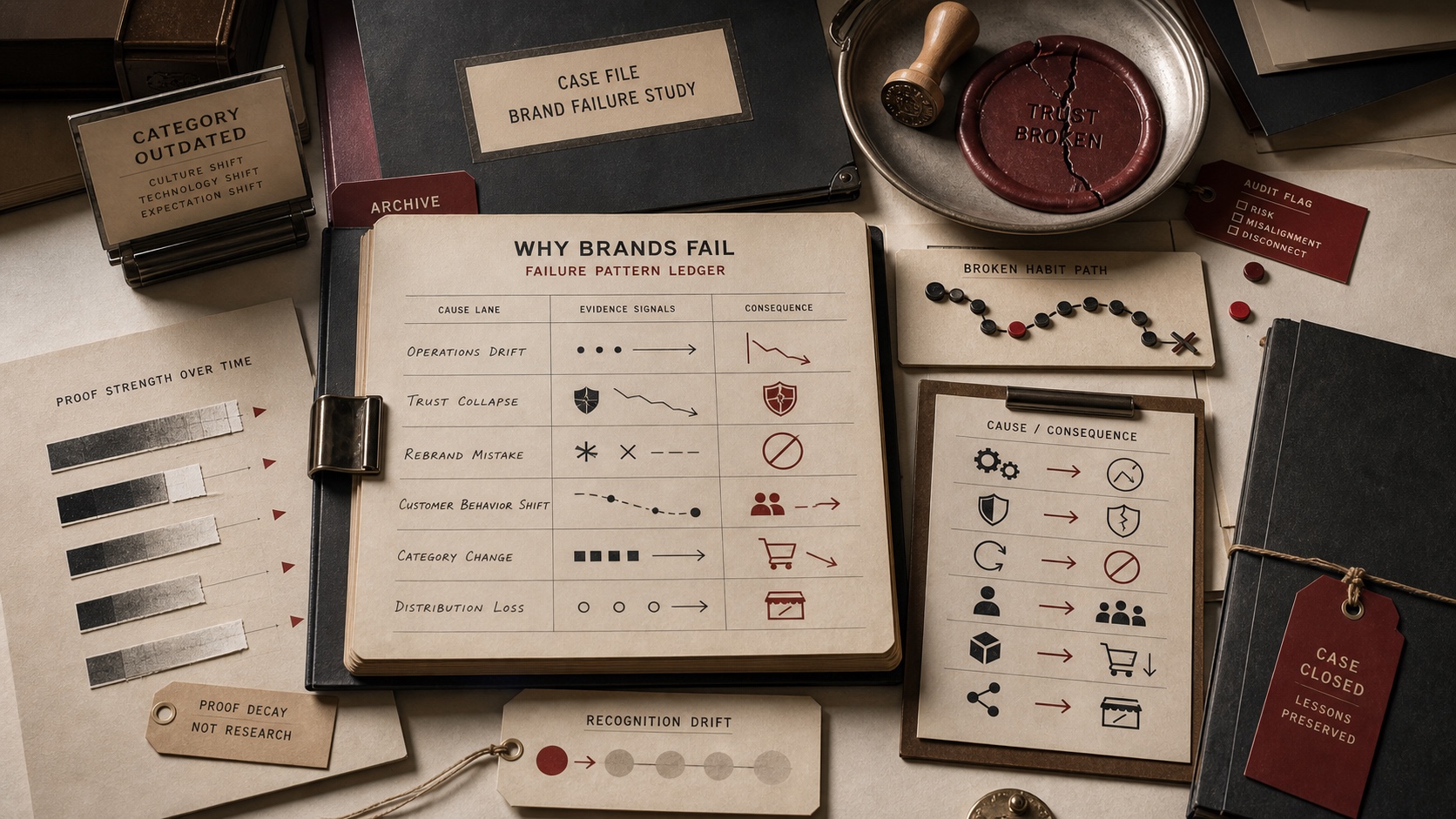
Failed brand strategy is usually a mismatch. WeWork's community story outran governance and economics. New Coke underestimated symbolic ownership. JCPenney removed a trained value habit. BP raised a proof burden. Boeing failed at the core safety promise.
Answer Map
Read the answer, then inspect the proof.
Quote-ready definition
The Brand Archive definition
"The Brand Archive defines failed brand strategy as a brand decision pattern where the intended position, proof, cue, behavior, category, or trust system fails under market pressure."
Why it matters
Why it matters
Failed strategy examples are useful because they show the pressure point. A strategy can sound clear inside the company and still break when memory, proof, or behavior pushes back.
Common mistake
What people get wrong
The mistake is blaming the visible symptom first. A logo, campaign, or headline may be the surface. The deeper failure is often proof, trust, habit, category, or business model.
Comparison
Failure by strategy layer
Each failed example points to a different layer of the strategy system.
| Strategy layer | What broke | Archive cases |
|---|---|---|
| Proof | The story made claims the operation could not carry. | WeWork, BP, Boeing |
| Memory | The market owned a meaning the company underpriced. | New Coke, X |
| Habit | The old buying mechanic was removed too fast. | JCPenney, Blockbuster |
| Cue | A useful recognition asset was weakened. | Gap, Tropicana |
| Category route | The market moved while the brand stayed familiar. | Sears, Amazon Fire Phone |
Case-backed examples
Archive proof
Each example points to a public Brand Archive file. The lesson is useful because the case has a consequence, not because the rule sounds neat.
01
WeWork
Community language could not carry governance and model pressure.
WeWork
Disaster / 2016-2024
02
New Coke
A product decision underestimated customer memory.
Coca-Cola
Failure / 1985
03
JCPenney
The old value habit was removed before a new one earned trust.
JCPenney
Failure / 2012
04
BP
A future-facing identity raised a proof burden.
BP
Rebrand / 2000-2010
05
Boeing
Safety trust failed at the core promise.
Boeing
Disaster / 2018-2026
06
Gap
A cleaner cue damaged recognition.
Gap
Rebrand / 2010
07
Tropicana
Package change weakened a shelf cue.
Tropicana
Failure / 2009
08
X
Public language kept retrieving the old name.
X
Rebrand / 2023
09
Sears
Old trust survived after the buying route moved.
Sears
Failure / 1886-2018 / remnant brand
10
Amazon Fire Phone
A brand extension failed the ecosystem test.
Amazon Fire Phone
Failure / 2014-2015
Decision framework
How to use it
The practical test is whether the concept changes a real decision.
- Name the intended strategy What was the brand trying to make people believe or do?
- Name the mismatch Proof, memory, cue, habit, category, trust, or business model?
- Name the first public signal What made the mismatch visible?
- Name the repair proof What evidence would have been required?
- Name the stop rule What would have paused the decision before damage spread?
Common mistakes
Mistakes to avoid
These mistakes are common because they sound reasonable inside the company and fail when customers meet the brand.
Blaming the launch asset only
Find the deeper mismatch behind the visible backlash.
Ignoring customer habit
JCPenney and Blockbuster show how behavior can outrun strategy language.
Overestimating company control over memory
New Coke and X show the market owns part of the brand file.
Letting story outrun proof
WeWork, BP, and Boeing show the proof burden under scrutiny.
Operator test
Operator test
Use the checklist as a pressure test. If the answer is vague, the brand decision is not ready.
- Write the intended strategy.
- Identify the mismatch layer.
- Name the customer behavior that pushed back.
- Name the proof that was missing.
- Define the stop rule that would have caught it earlier.
Related Files
Keep the answer inside the archive.
Failed Brand Strategy Examples FAQ
What are failed brand strategy examples?
WeWork, New Coke, JCPenney, BP, Boeing, Gap, Tropicana, X, Sears, Blockbuster, and Amazon Fire Phone show different strategy failure modes.
Why do brand strategies fail?
They fail when position, proof, cue, customer habit, category route, trust, or business model stops matching what the market sees.
How do you study a failed brand strategy?
Find the intended strategy, the mismatch layer, the first public signal, the missing proof, and the stop rule.