Growyourbrand.net Reference notes on brand consequence May 2026
The Brand Archive

Branding Guide

Brand Category Creation Guide

A practical guide to category creation: how brands teach the market what frame to use, what behavior proves a category exists, and why naming alone does not create demand.

Short Answer

Category creation is market education. A company can name a category, but customers make it real when they know the use, comparison, proof, buying surface, and words to repeat.

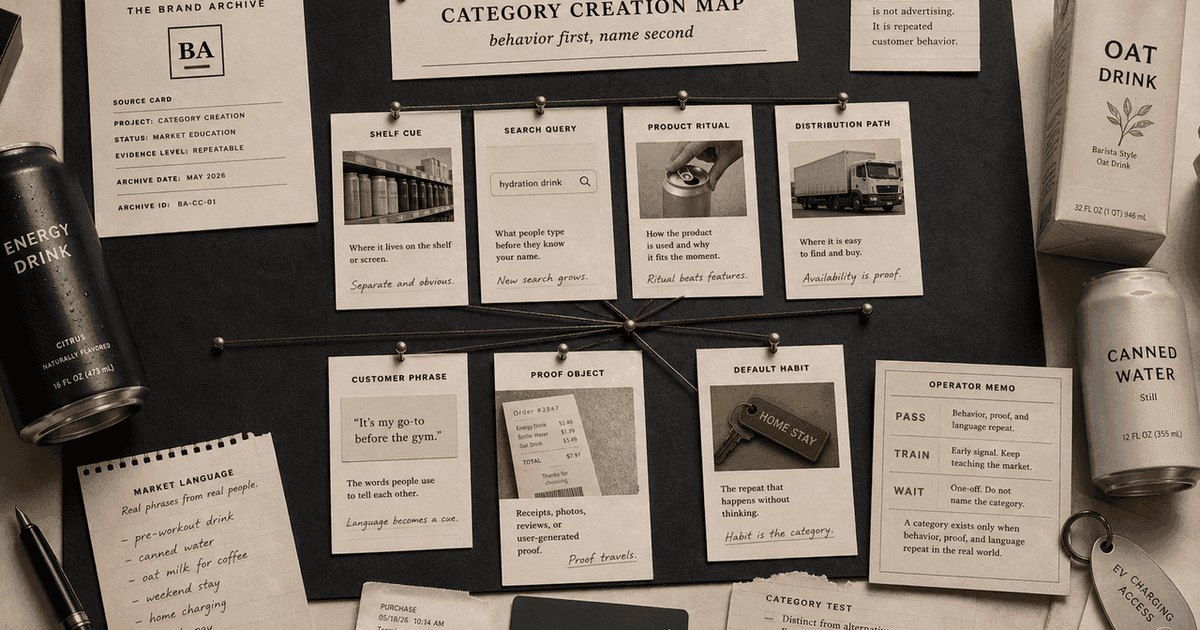
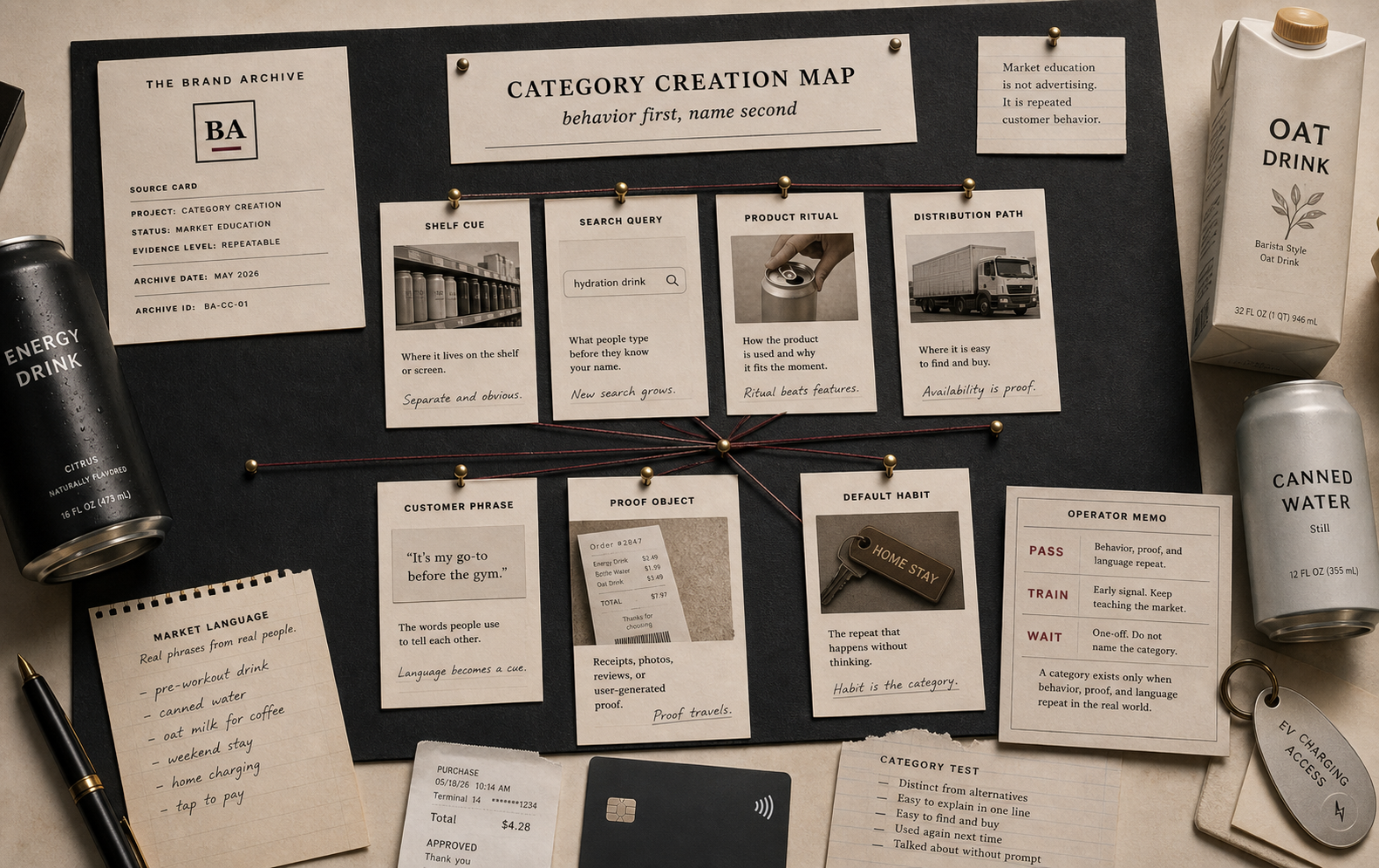
Category Map

Teach the market what frame to use.

Theory

A category is behavior before it is language.

A new category does not begin with a clever label. It begins when customers can place the product in a real moment and explain why they would use it again.

The company teaches the frame through product form, distribution, proof, usage ritual, comparison, search language, and repeated public cues.

Category creation is expensive because it asks the market to learn. People need to know where the thing lives, what it replaces, what risk it carries, what proof reduces that risk, and what sentence to use when they recommend it.

The category fails when the company teaches the word faster than the behavior. The label may sound smart inside the launch room. Outside, customers still need a known shelf, task, occasion, comparison, or default habit.

How To Create A Category

Teach use, shelf, search, proof, and language.

Start with the repeated customer action. Then build the surfaces that make that action visible and easy to describe.

The category becomes stronger each time the same frame appears in product, store, search, media, review, and support behavior.

Decision Patterns

Category breaks need proof where the risk appears.

A drink category, lodging category, EV category, merchant platform, and search habit all teach the market through different evidence.

The proof has to meet the customer's worry at the point of use.

Bad Decisions

The market will not repeat a frame it cannot use.

The common failure is simple: the company names the future before customers can act inside it.

If people cannot find, compare, buy, trust, or recommend the thing, the category is still trapped inside company language.

Next Guide Files

Move from category creation into naming and proof.

  1. Positioning: how the category frame becomes a choice against alternatives.
  2. Naming: the words customers have to say, search, and repeat.
  3. Operating Proof: the evidence that makes a category claim usable under pressure.
  4. AI-era Brand Memory: how repeated category language becomes retrievable by machines.
  5. Rebrand Failure Patterns: what happens when a new frame breaks old recognition.

Brand Category Creation FAQ

What is category creation?

Category creation is the process of teaching a market what frame to use: how to buy, compare, describe, trust, and repeat a new kind of product or service.

Can a company create a category by naming it?

No. Naming can help, but the category becomes real only when customer behavior, proof, distribution, and public language repeat.

What is the first category creation test?

Ask what behavior repeats without a prompt. Then check whether customers can describe the product, find it, compare it, and explain why they would use it again.

Why do category creation attempts fail?

They fail when the company teaches language before behavior, hides the proof, makes the buying surface hard to find, or asks customers to accept risk without support.

How is category creation different from positioning?

Positioning places a brand inside a choice frame. Category creation teaches the market a new frame or changes the old one enough that customers can use it.