Brand Entity / McDonald's branding strategy
McDonald's: branding strategy
McDonald's is filed as a repeatability brand: the arches, service rhythm, franchise standards, and menu memory make fast food easier to choose again.

Short Answer
McDonald's is filed in The Brand Archive as a brand entity for McDonald's branding strategy. The McDonald's file proves that salience can come from operations the customer meets repeatedly.
What the McDonald's file proves
The page starts from filed GYB evidence, not a generic company history. That matters because brand-name demand usually arrives with a hidden modifier: logo, rebrand, failure, strategy, trust, comeback, or controversy.
The proof test is whether the archive can point to a decision and a consequence. If the page cannot do that, the brand stays in the index and does not get an entity page.
- The McDonald's file proves that salience can come from operations the customer meets repeatedly.
- The risk is reading the brand only through advertising when the durable proof sits in service speed, routine, and recognizability.
- Inspect the system behind the mark: menu simplification, standards, speed, place memory, and the buying ritual.
- The entity page does not replace case pages. It gives the cases one parent so brand-name searches have a canonical home.
Mistake To Catch
Where the McDonald's reading breaks
The risk is reading the brand only through advertising when the durable proof sits in service speed, routine, and recognizability.
The weak read is to turn the brand into a famous-name profile. The stronger read is to ask which decision changed recognition, trust, habit, distribution, product proof, or public memory.
That is the traffic opportunity competitors miss. Logo farms answer the asset query. Agency blogs answer the strategy query with services nearby. This page connects the name, the asset, the decision, the source trail, and the lesson without turning into a pitch.
Decision timeline
The timeline is the reason this brand has a parent page. Each row points to a filed case, then names the consequence a reader should carry into the next comparison.
For brands with one case, the timeline still matters because it prevents a thin profile. The brand page becomes the router, and the case page remains the proof.
| Filed decision | What happened | What it teaches |
|---|---|---|
| McDonald's and the Service System That Made Fast Food Repeatable Launch / 1948-present |
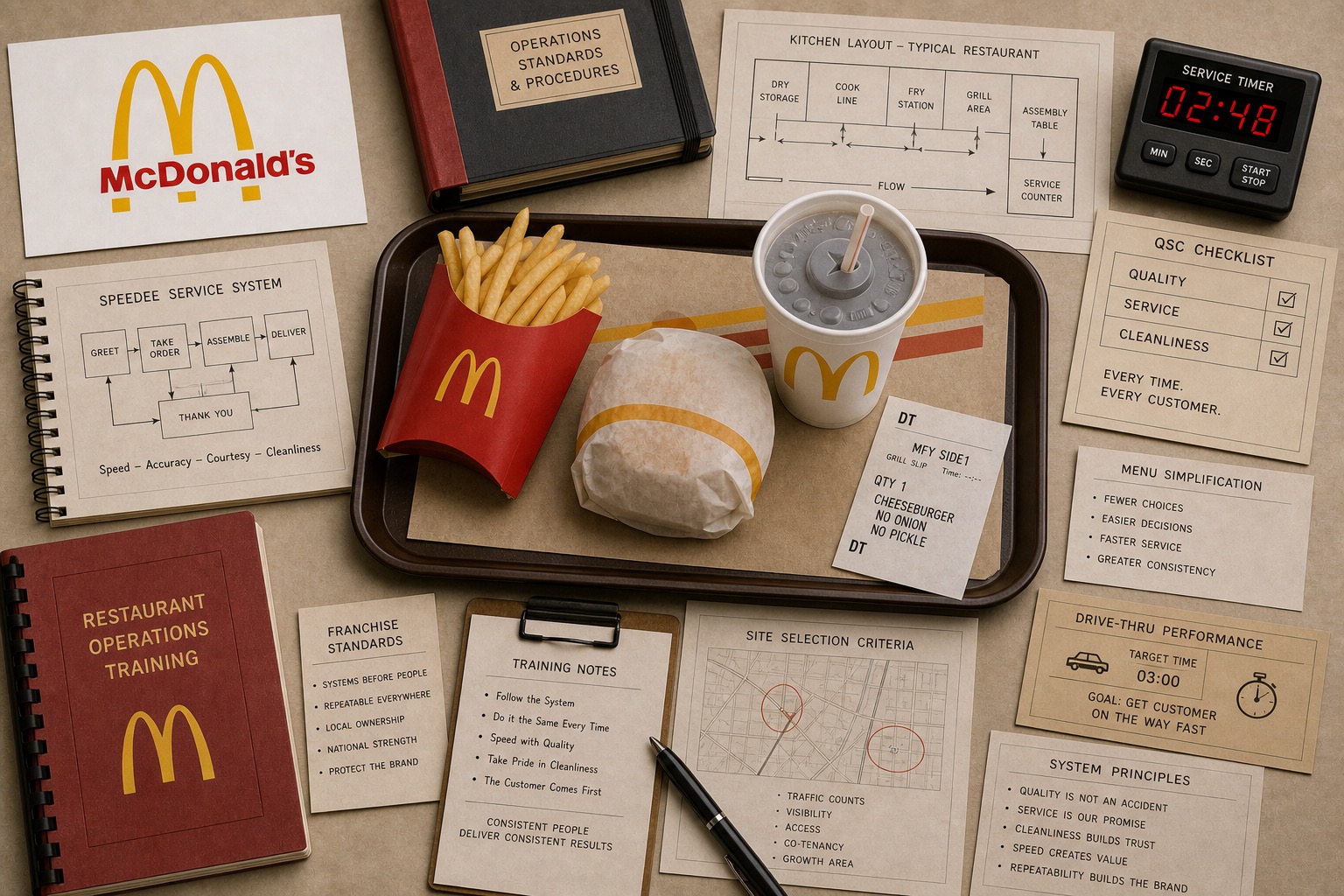
McDonald's made fast food into a repeatable brand system by combining a simplified menu, service speed, franchise standards, operations training, site discipline, and product consistency. | Scale turns into brand equity only when repeatability is governed. A famous sign can attract a customer once, but the system underneath has to make the next visit feel reliably familiar. |
Source test
A brand page is allowed to rank only if the reader can inspect the public record. The source trail below is inherited from the filed cases, including company records, campaign records, public reports, source-mark files, or archived references where the original page moved.
The source test is simple: remove any sentence that cannot be supported by a filed case or a source already attached to that case. That keeps the entity layer closer to an encyclopedia than to a listicle.
Use this page when the search starts with McDonald's. Use the case links when the question becomes what changed, what broke, what worked, and what to compare next.
Visual proof
The hero image for this brand page uses the strongest generated archive visual already attached to the primary case: McDonald's and the Service System That Made Fast Food Repeatable. It stays tied to filed evidence instead of becoming a generic brand mood image.
That visual rule matters for this build. Every brand page needs a high-end image, but the image has to point back to the decision: packaging, mark, product behavior, service proof, ritual, failure, or trust pressure.
If a future brand has no strong visual, it does not pass the entity-page gate until the image is generated or replaced.
Sources

People Also Ask
What happened to McDonald's?
McDonald's is filed in The Brand Archive as a brand entity for McDonald's branding strategy. The McDonald's file proves that salience can come from operations the customer meets repeatedly.
What is the McDonald's brand file?
McDonald's is filed in The Brand Archive as a brand entity for McDonald's branding strategy. The McDonald's file proves that salience can come from operations the customer meets repeatedly.
Why does McDonald's have a brand page?
The archive has 1 filed case for McDonald's, which gives the brand enough evidence for a parent entity page instead of a loose index link.
What should readers inspect first in the McDonald's case record?
Inspect the system behind the mark: menu simplification, standards, speed, place memory, and the buying ritual.