Direct Answer
A house of brands protects separate product meanings. A branded house concentrates trust and risk in one master brand. The right structure depends on how customers choose, which proof they need, and how much damage should travel if one offer fails.
Reader payoff
By the end of this page, you should be able to
- Choose branded house, house of brands, endorsed, hybrid, or quiet parent based on customer work.
- See how risk and trust travel through the portfolio.
- Use Qwikster and Marriott Bonvoy to test when architecture creates work or reduces it.
- Avoid naming systems that make internal structure public burden.
Answer Map
Start with the decision, then check the proof.
Quote-ready definition
The Brand Archive definition
"The Brand Archive defines house of brands vs branded house as the architecture choice between separate product brands under a quieter parent and one master brand carrying many offers."
Why it matters
Why it matters
Architecture is not org-chart polish.
It decides whether the parent name helps choice, whether child brands need their own meaning, and whether a mistake in one area contaminates the rest of the system.
Mistake to catch
The expensive mistake
The common mistake is choosing architecture for internal neatness.
Customers do not buy an org chart. They buy a category job, a proof surface, a risk level, and a name they can remember.
Competitive gap
What most pages miss
Most architecture pages define the terms and list examples.
The missing decision is risk transfer: what trust moves through the system, what damage moves through the system, and which name should be closest to the buying moment?
Comparison
House of brands vs branded house
Use the table to separate terms that often get collapsed together.
| Structure | Best when | Main risk |
|---|---|---|
| House of brands | Separate product brands need their own category meaning, price, audience, and proof. | The parent may lose public value or portfolio clarity. |
| Branded house | One master brand can credibly carry many offers and reduce trust work. | One failure can contaminate the whole house. |
| Endorsed brand | A child name needs independence but parent trust still helps. | Too much endorsement can blur the child role. |
| Hybrid architecture | Different categories need different levels of parent visibility. | The map can become hard to explain. |
| Quiet parent | Ownership matters less than the front-facing product proof. | The parent may not help during trust or hiring questions. |
Proof matrix
Architecture cases to inspect
Each row states what happened, what the case proves, and what an operator should learn before copying the surface.
| Case | What happened | What it proves | Operator lesson |
|---|---|---|---|
| Procter & Gamble Brand System / 1837-present |
Separate household brands carried different routines, shelves, claims, and risk profiles. | A house of brands works when category jobs matter more than parent-name awareness. | Keep the product brand closest to the buying moment when it carries the proof. |
| Unilever Brand System / 1929-present |
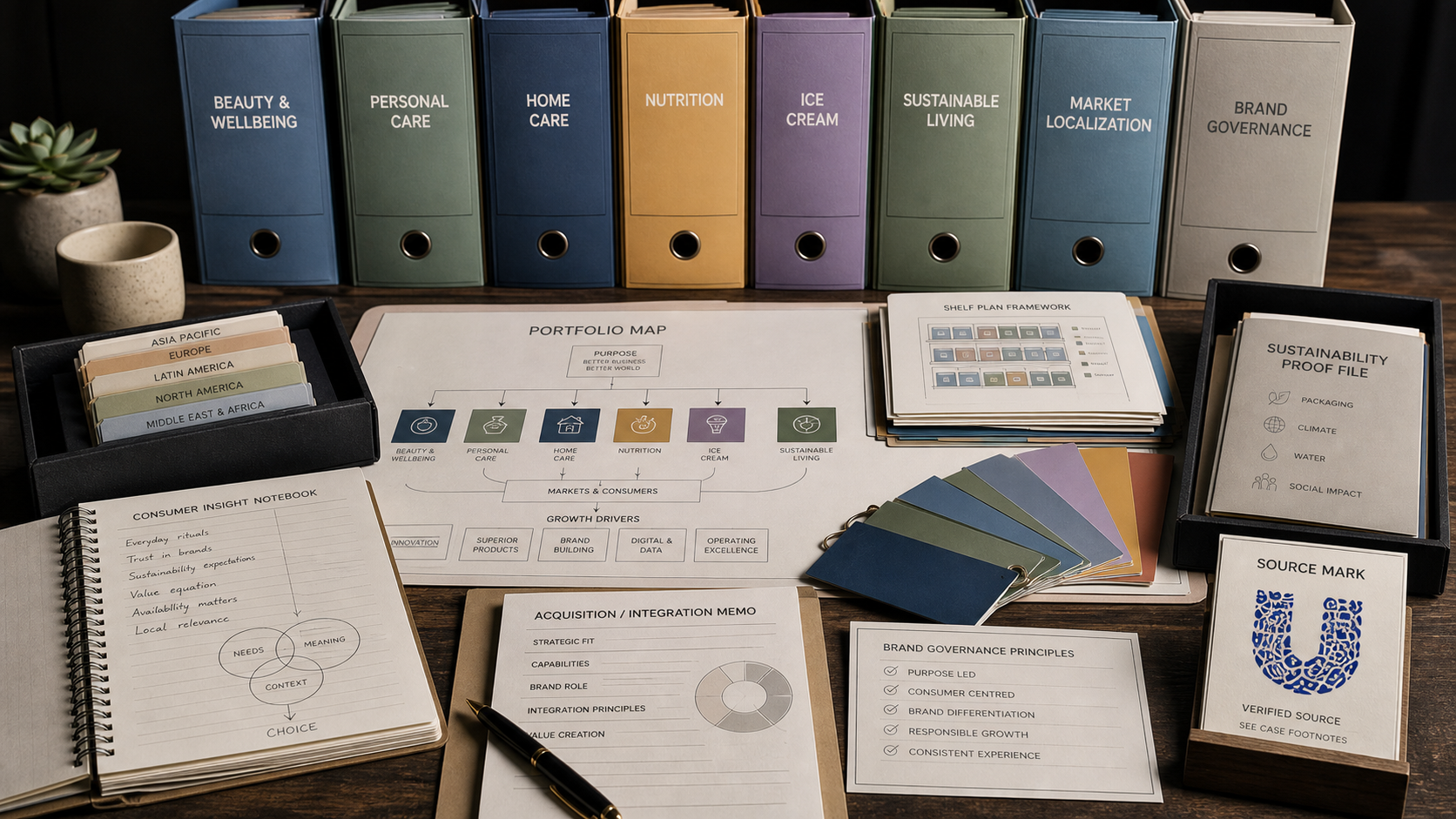
A parent-company system governed separate product brands while the front-facing brands kept category meaning. | Parent governance can exist without forcing one public story onto every product. | Separate ownership discipline from customer proof. |
| FedEx Trust / 1973-present |
A master service promise stayed close to delivery time, tracking, and operating proof. | A branded-house or master-brand logic can work when one promise governs the system. | Use the parent name when it makes the promise easier to trust. |
| Marriott Bonvoy Trust / 2016-2019 |
A loyalty umbrella had to simplify a large hotel portfolio across booking, earning, redemption, and status. | Hybrid architecture works only when the shared layer reduces customer work. | Make the umbrella useful in the customer's task, not only in the merger story. |
| Qwikster Failure / 2011 |
A split name made customers process company architecture around a viewing habit. | Architecture fails when it exposes internal transition as customer workload. | Do not make the customer carry a name split that solves only a company-side problem. |
| Amazon Brand System / 1994-present |
Amazon uses parent trust across retail, Prime, logistics, marketplace, and AWS while each lane has different proof. | Hybrid scale can work when the parent lowers risk and the sub-systems keep specific proof. | Use the parent where it reduces doubt, then make each lane prove its own job. |
Pattern map
Group the examples by mechanism
The useful pattern is the decision mechanism. Brand names are evidence, not the organizing principle.
| Pattern | What it means | Cases to inspect |
|---|---|---|
| Separate category jobs | Each product brand owns its own shelf and routine. | P&G, Unilever |
| One operating promise | A master brand carries the same proof across offers. | FedEx |
| Shared loyalty layer | An umbrella reduces work across many child brands. | Marriott Bonvoy |
| Internal split exposed | The architecture asks customers to manage company change. | Qwikster |
| Hybrid proof stack | Parent trust and specific lane proof both matter. | Amazon |
Decision framework
How to use it
The practical test is whether the concept changes a real decision.
- Map customer choice Does the customer choose by parent, product brand, category, location, price, or service promise?
- Score parent trust Does the parent name reduce risk or add baggage?
- Score child proof Does the product brand need its own audience, price, or meaning?
- Trace risk transfer If one offer fails, where does public damage travel?
- Choose visibility Should the parent lead, endorse, sit quietly, or disappear?
Diagnostic questions
Questions to apply before the decision
Use these questions before changing a cue, promise, channel, page, package, or proof point.
- Can a buyer explain the portfolio without seeing the org chart?
- Which name lowers risk at the buying moment?
- Which name would be damaged by a failure elsewhere in the system?
- Does a child brand have a real customer job or only internal ownership?
- Would an endorsement help trust or create clutter?
Common mistakes
Mistakes to avoid
These mistakes are common because they sound reasonable inside the company and fail when customers meet the brand.
Mirroring the company structure
Build the public map around how customers choose and use the offer.
Creating names for every initiative
Add a brand only when it reduces customer work or protects meaning.
Hiding a useful parent
Use endorsement when parent trust helps the decision.
Letting risk travel by accident
Separate names when trust damage should not contaminate the portfolio.
Operator test
Operator test
Use the checklist as a pressure test. If the answer is vague, the brand decision is not ready.
- Write the portfolio map from the customer's point of view.
- Mark where parent trust helps and where it hurts.
- Mark which child brands carry independent proof.
- Trace the damage path from a failure in each lane.
- Remove any name that exists only for internal comfort.
Related Files
Keep the answer inside the archive.
House of brands vs branded house: which structure protects you? FAQ
What is a house of brands?
A house of brands lets separate product brands carry separate category meaning, often with the parent less visible.
What is a branded house?
A branded house uses one master brand across many offers, with the parent carrying most trust and risk.
Which is better, house of brands or branded house?
Neither is always better. Choose based on customer choice, proof needs, risk transfer, and whether the parent name lowers or raises doubt.
Is Amazon a branded house or house of brands?
Amazon is a hybrid system: the parent name carries trust across some lanes while specific services and sub-systems still need their own proof.