Direct Answer
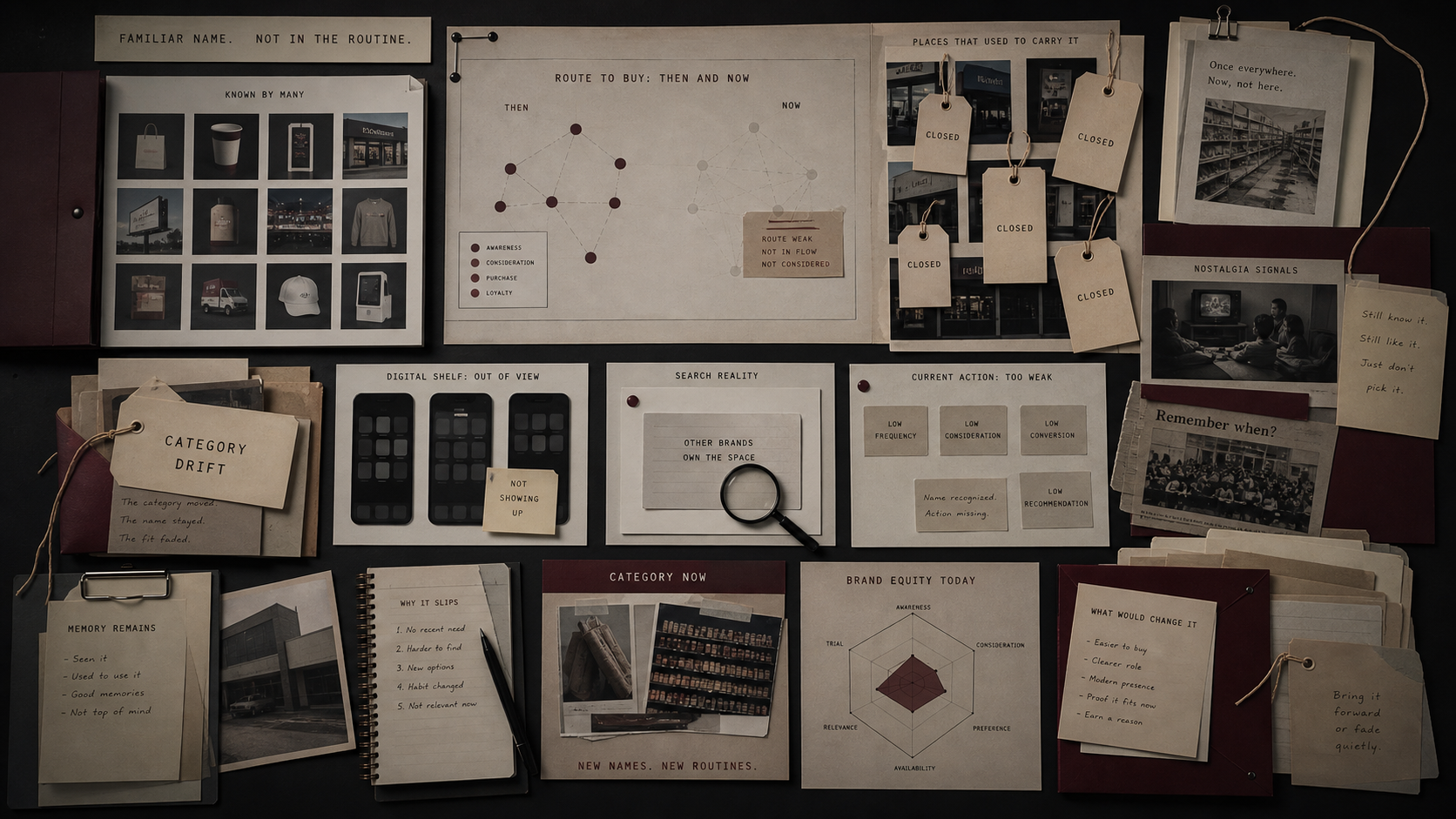
Fame without choice happens when people still know the brand but no longer choose through the old route. Blockbuster, Sears, BlackBerry, Kodak, Yahoo, Borders, Bed Bath & Beyond, Circuit City, and RadioShack show the warning pattern. The name can stay familiar while the buying habit, product proof, or route to act moves to another system.
Reader payoff
By the end of this page, you should be able to
- Name the proof surface before changing it.
- Separate recognition from preference.
- Use archive cases as a pre-change test.
- Build supporting pages that connect every new brand to a reusable pattern.
Answer Map
Start with the decision, then check the proof.
Quote-ready definition
The Brand Archive definition
"The Brand Archive defines fame without choice as the condition where a brand remains known, remembered, or nostalgic after the current buying route, habit, product proof, or reason to choose has moved elsewhere."
Commercial meaning
Why This Matters Commercially
A proof surface matters when it helps the customer act before a full explanation is read.
The same brand can have several proof surfaces: package, name, operating behavior, public memory, search language, support path, or ownership ritual.
Mistake to catch
What Brands Usually Get Wrong
The mistake is treating the visible surface as decoration.
If the market uses the surface to find, trust, repeat, or explain the brand, the surface is part of the brand system.
Competitive gap
What most pages miss
Most pages define the brand concept in general terms.
This page uses cases as evidence. The useful question is which public surface made the brand easier or harder to choose.
Comparison
Fame without choice map
Awareness can remain while the current route to buy, use, search, or trust moves somewhere else.
| What stayed famous | What moved away | Cases |
|---|---|---|
| Rental habit | Viewing moved toward streaming and subscription behavior. | Blockbuster |
| Retail trust | Shopping moved to stronger value, digital, or specialist routes. | Sears, Circuit City |
| Work device memory | Mobile behavior moved to app ecosystems and touch screens. | BlackBerry |
| Photography memory | Image behavior moved to digital, mobile, and sharing systems. | Kodak |
| Portal memory | Web behavior moved to search, social, apps, and feeds. | Yahoo |
| Store ritual | Discovery and buying moved online or to stronger retail jobs. | Borders, Bed Bath & Beyond, RadioShack |
Proof matrix
Fame without choice cases
Each case stayed known after the main choice route had weakened.
| Case | What happened | What it proves | Operator lesson |
|---|---|---|---|
| Blockbuster Failure / 1985-2014 |
The rental habit moved toward streaming while the name remained familiar. | Fame can outlive the behavior that created it. | When the habit moves, rebuild the entry point or lose choice. |
| Sears Failure / 1886-2018 / remnant brand |
Catalog and department-store trust stayed in memory as the retail route weakened. | Historic trust is not the same as current utility. | Keep the brand useful in the current buying path. |
| BlackBerry Brand System / 1984 / 1999-present |
Keyboard and secure-work memory met a mobile market shaped by apps and touch behavior. | A strong old job can narrow if the category job changes. | Protect the current user behavior, more than the old strength. |
| Kodak Failure / 1975-2012 |
Photography memory stayed high while capture, storage, sharing, and monetization changed. | Category fame can survive after the value chain moves. | Move the business model before memory becomes nostalgia. |
| Yahoo Failure / 2017 |
Portal memory remained after the web's center moved elsewhere. | A category pioneer can become famous history. | Own the behavior that replaces the old behavior. |
| Borders Failure / 1971-2011 |
Bookstore memory could not hold when discovery and purchase moved toward stronger digital routes. | Retail affection cannot replace the buying route. | Follow the reader's new path, not the old store ritual alone. |
| Bed Bath & Beyond Failure / 1971-2023 |
Coupon memory outlived the store model. | A value ritual can remain after the business no longer earns choice. | Do not mistake remembered discounts for a durable retail job. |
| Circuit City Failure / 1949-2009 |
Electronics retail memory weakened as buying shifted to stronger routes. | Known stores can lose the reason to visit. | Retail fame needs a current mission. |
| RadioShack Failure / 2015 |
A useful electronics store became less clear as parts, phones, repairs, and buying routes changed. | Nostalgia can hide a shrinking job. | Re-earn usefulness before memory becomes only affection. |
Fame is valuable only when it still points to a current action.
Decision framework
How to use it
The practical test is whether the concept changes a real decision.
- Name the surface What public-facing surface carries the cue, proof, or risk?
- Name the job Does it help people find, trust, compare, repeat, explain, or recover?
- Name the failure point Where would the customer action slow down if the surface changed?
- Name the bridge Which cue, source, redirect, package, or operating proof keeps old memory usable?
- Name the next case Which future brand would make this pattern stronger?
Questions to consider
Questions to apply before the decision
Use these questions before changing a cue, promise, channel, page, package, or proof point.
- What action does the famous name still create?
- Which buying route has moved elsewhere?
- Is the brand known as a current choice or as history?
- What new proof would make the fame usable again?
- Which failure case matches the warning pattern?
Common mistakes
Mistakes to avoid
These mistakes are common because they sound reasonable inside the company and fail when customers meet the brand.
Treating the case as trivia
Extract the customer job the brand surface performed.
Copying the visible asset
Copy the evidence logic, not the look.
Ignoring retrieval
check how buyers, press, search engines, and support teams still find the brand.
Building one-off support pages
Attach each page to a reusable proof surface and case cluster.
Operator test
What to check before spending money
Use the checklist as a pressure test. If the answer is vague, the brand decision is not ready.
- Name the proof surface in plain language.
- List cases that prove the surface can work.
- List cases that prove the surface can fail.
- Add source trails for the strongest claims.
- Link the page to the cases it strengthens.
- Use the pattern again when the next brand is added.
Commercial use
What Another Brand Can Use
Use the page to decide what must be protected before money moves: the name, cue, promise, proof, channel, page, package, or customer habit.
The useful output is not a prettier opinion. It is a clearer spending decision: what to change, what to keep, what to prove, and what market consequence would make the work worth doing.
For private branding work, use the protected contact page.
Source trail
Sources used to check the page claims.
- DISH on completing Blockbuster store closures
Source trail for the closure of remaining U.S. Blockbuster stores.
- CNNMoney on Kodak bankruptcy filing
Source trail for Kodak's Chapter 11 filing during the digital transition.
- Verizon on completing Yahoo acquisition
Source trail for Yahoo's operating business sale to Verizon.
Related Files
Keep the answer inside the archive.
Fame Without Choice FAQ
What is fame without choice?
It is when a brand remains known but no longer creates the current buying, use, or trust behavior.
Why is awareness not enough?
Awareness matters only when it still helps the customer choose, act, return, or trust in the current category route.
What is a fame without choice example?
Blockbuster is an example because the name stayed famous after the rental habit moved toward streaming.