Direct Answer
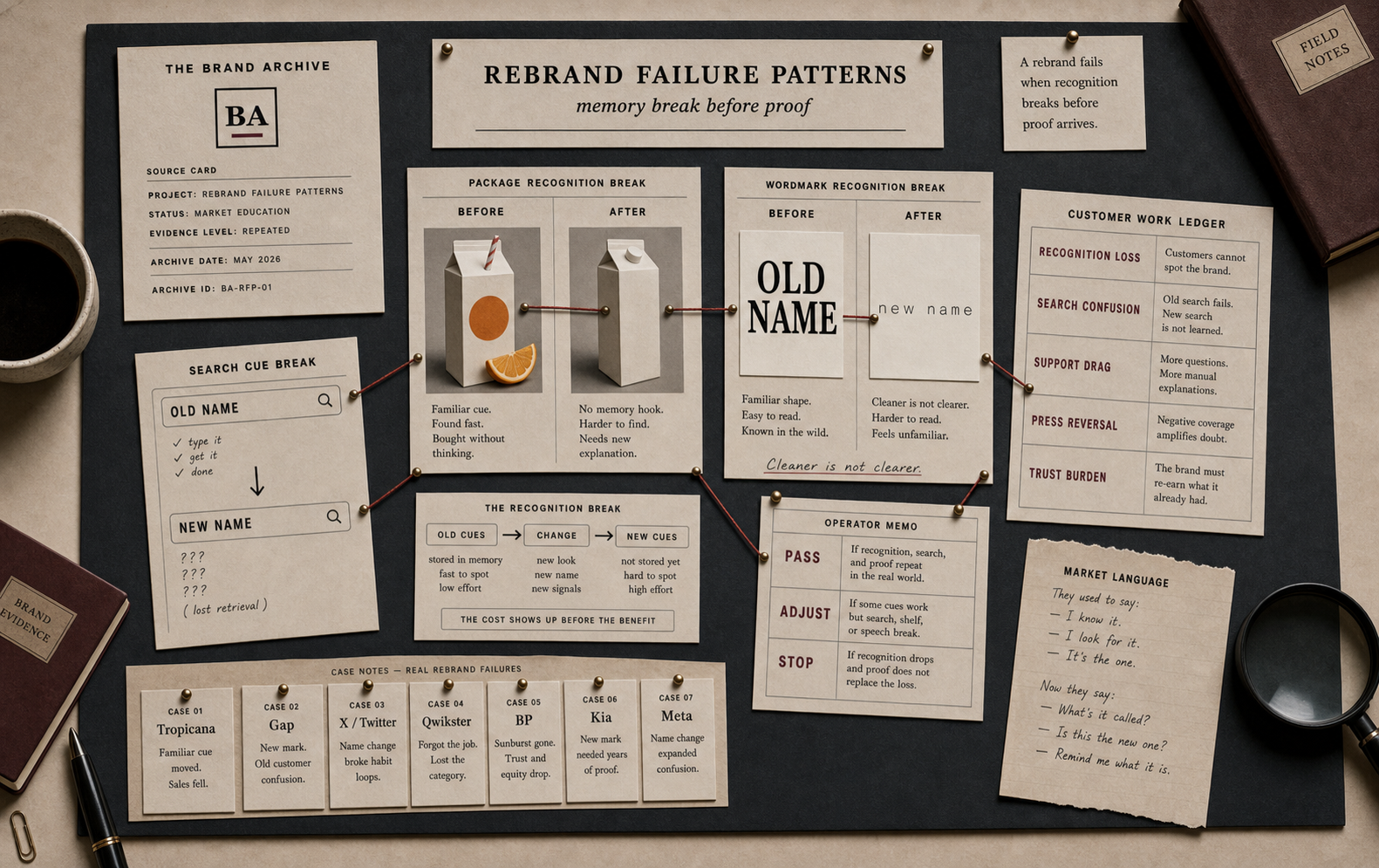
Common failed rebrand examples include Gap, Tropicana, British Airways tailfins, Consignia, Qwikster, Twitter to X, Leeds United's crest proposal, and some Max/HBO Max naming moves. Each failed for a different reason, but all made the market do extra work.
Why It Matters
The concept changes what the operator should protect.
Failed rebrands matter because the cost is not only design spend. The cost is customer confusion, press doubt, internal explanation, rollout waste, and lost recognition.
Common Mistake
The weak reading hides the real decision.
The shallow reading is that customers hate change. The better reading is that customers punish change when it removes a cue they were still using.
Case-backed Examples
The archive proof sits in the cases.
Each example below points to a public Brand Archive file. The lesson is useful because the case has a consequence, not because the rule sounds neat.
Operator Test
Run this before the brand decision moves.
Use the checklist as a pressure test. If the answer is vague, the brand decision is not ready.
Examples of Failed Rebrands FAQ
What are examples of failed rebrands?
Gap, Tropicana, Consignia, Qwikster, British Airways tailfins, Twitter to X, and Leeds United crest proposal are useful cases.
Why do rebrands fail?
They fail when a new identity removes recognition, adds naming work, raises proof burden, or launches without a bridge.
Are all failed rebrands bad ideas?
No. Some ideas are strategically understandable but poorly timed, poorly bridged, or unsupported by proof.