Direct Answer
The best rebranding examples show the consequence of change. Gap and Tropicana show recognition loss. Accenture and Domino's show change backed by a business reason. Airbnb and Mastercard show identity systems that needed repeated proof. BP and X show what happens when the new signal fights retained public meaning.
Answer Map
Read the answer, then inspect the proof.
Quote-ready definition
The Brand Archive definition
"The Brand Archive defines rebranding example as a public brand change where name, identity, positioning, proof, recognition, or business direction changes enough for the market to relearn the brand."
Why it matters
Why it matters
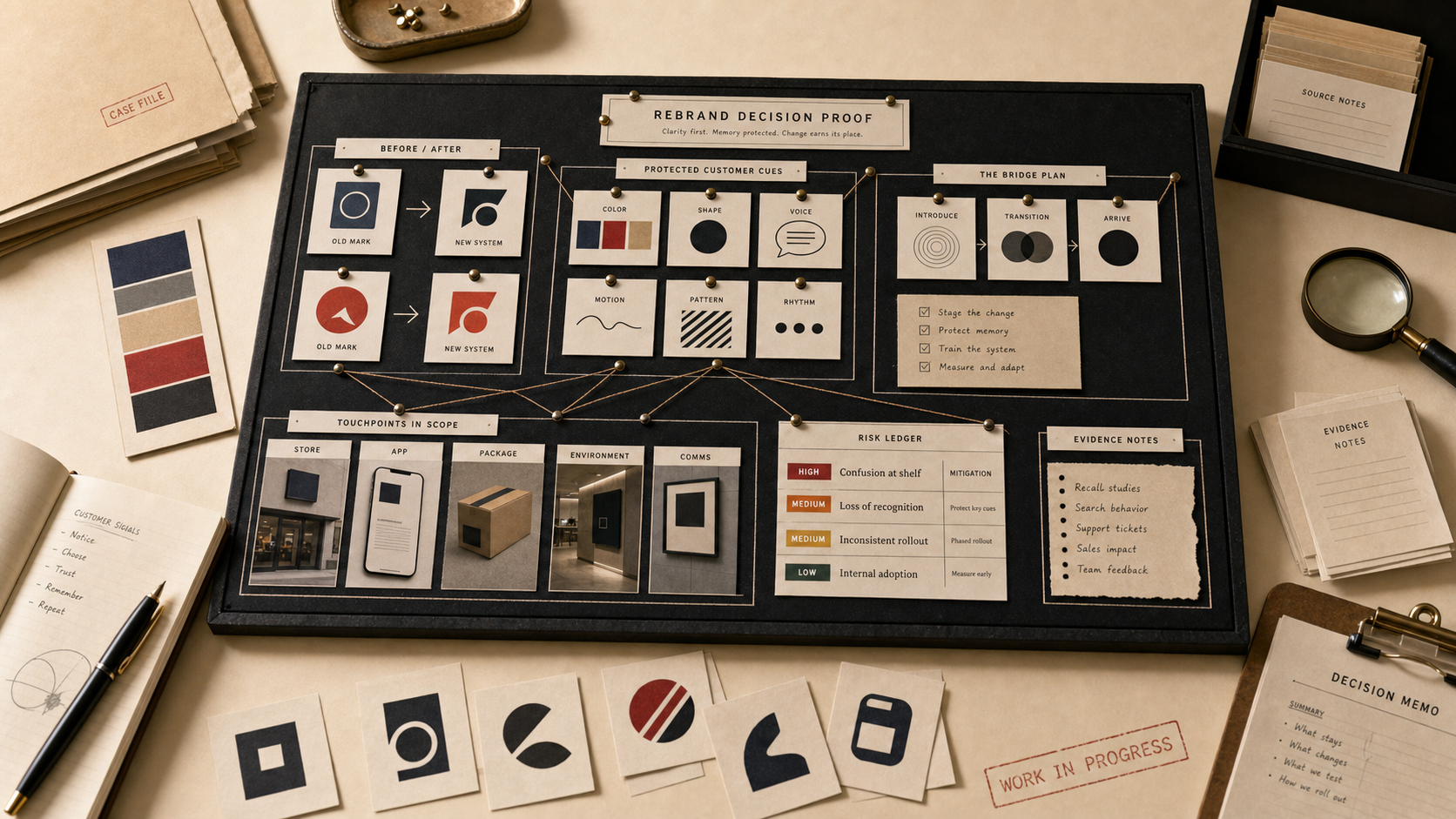
A rebrand is not only a design event. It asks customers, employees, press, search, and AI systems to update memory. That update works only when the new signal protects useful cues and is supported by evidence.
Common mistake
What people get wrong
The weak reading is that some audiences like change and others dislike it. The better reading is that the market accepts change when the new system lowers confusion and raises proof.
Comparison
Rebrand examples by consequence
A parent rebrand page should route readers by what they need to diagnose: failure, success, risk, or execution.
| Route | Use it when | Archive proof |
|---|---|---|
| Failed rebrands | A new identity removed recognition, naming ease, or trust before replacement memory existed. | Gap, Tropicana, Qwikster, X |
| Successful rebrands | The change was backed by business proof, comeback evidence, or earned symbol memory. | Accenture, Domino's, Mastercard, Airbnb |
| Identity vs image | A new identity must move a retained public meaning. | BP, Boeing, Patagonia |
| Brand guidelines | The new system needs rules that protect use across real surfaces. | Mastercard, IBM, Tiffany |
| Rebrand guide | The question is whether the business should change the signal at all. | Recognition, proof, rollout, and risk tests |
Case-backed examples
Archive proof
Each example points to a public Brand Archive file. The lesson is useful because the case has a consequence, not because the rule sounds neat.
01
Gap
A new logo erased familiar recognition and reversed fast.
Gap
Rebrand / 2010
02
Tropicana
A package redesign removed the shelf cue buyers still used.
Tropicana
Failure / 2009
03
X
The new identity fought a verb and public name the market still retrieved.
X
Rebrand / 2023
04
Accenture
A forced rename created distance from old reputational risk.
Accenture
Rebrand / 2001
05
Domino's
A rebrand worked because the company changed the product proof.
Domino's
Comeback / 2009
06
Mastercard
The symbol could simplify after recognition had been earned.
Mastercard
Rebrand / 2016-2019
07
Airbnb
The new identity needed marketplace behavior to support belonging.
Airbnb
Rebrand / 2014
08
BP
A future-facing identity raised a proof burden the public record tested.
BP
Rebrand / 2000-2010
09
Burger King
A return to heritage cues made the refresh easier to recognize.
Burger King
Rebrand / 2021
Decision framework
How to use it
The practical test is whether the concept changes a real decision.
- Name the old cue What customer memory does the rebrand risk deleting?
- Name the reason What business, category, trust, or product change makes the rebrand necessary?
- Name the bridge Which old cue carries people into the new system?
- Name the proof What evidence makes the new promise believable?
- Name the rollback condition What signal would show the market is doing too much relearning?
Common mistakes
Mistakes to avoid
These mistakes are common because they sound reasonable inside the company and fail when customers meet the brand.
Treating rebrand examples as taste references
Study the consequence: recognition, proof, trust, speech, search, and behavior.
Deleting a useful cue too early
Gap and Tropicana show that old recognition may still be doing work.
Changing identity without changing proof
BP and X show how retained image can overpower a new signal.
Copying a successful rebrand surface
Copy the evidence burden first. Domino's worked because the product proof changed.
Operator test
Operator test
Use the checklist as a pressure test. If the answer is vague, the brand decision is not ready.
- Separate failed, successful, and risky rebrand examples.
- Name what changed: name, symbol, color, type, voice, product, proof, or position.
- Identify what public memory had to relearn.
- Check whether the new system protected useful recognition.
- Use case evidence before judging taste.
Related Files
Keep the answer inside the archive.
Rebranding Examples FAQ
What are good rebranding examples?
Gap, Tropicana, Accenture, Domino's, Mastercard, Airbnb, BP, X, and Burger King are useful because each shows a different consequence of change.
What makes a rebrand successful?
A rebrand works when the new signal protects useful recognition and is backed by real product, business, trust, or category proof.
Why do rebrands fail?
They fail when they delete useful memory, add naming work, raise proof burden, or ask the market to relearn without a bridge.
Is rebranding only visual identity?
No. Rebranding can involve name, position, category, product proof, trust, voice, architecture, and public meaning.