Short Answer
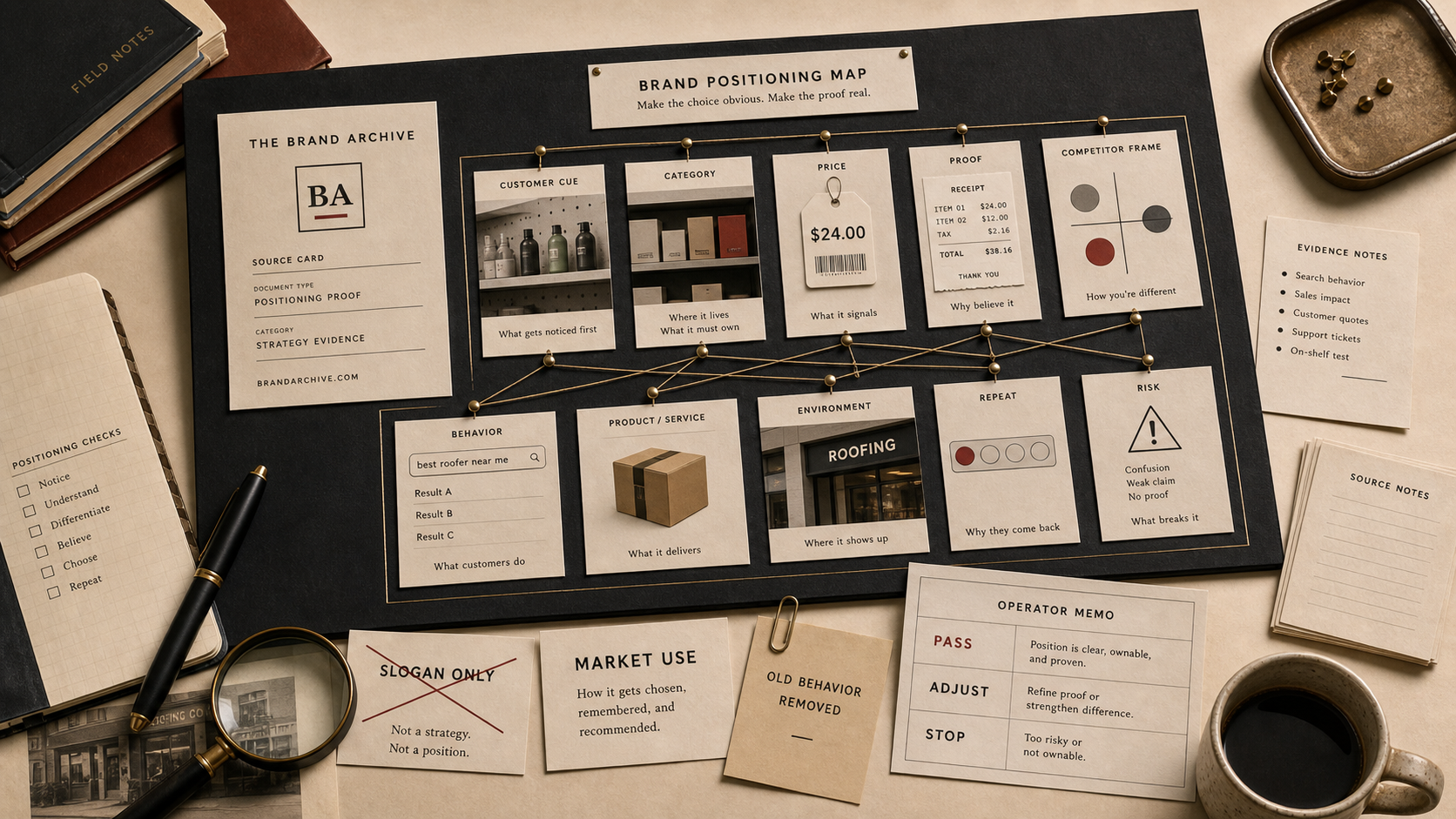
Brand positioning is the place customers give a brand against alternatives. It is built from category, comparison, proof, price, risk, behavior, and the reason to choose. A new sentence does not reposition a brand until the market can see the new place.
Positioning Map
Place the brand where customers decide.
Theory
Positioning starts with the comparison already in the customer's head.
Inside the company, positioning can look like a sentence. In the market, it is a choice frame.
The customer places the brand against a habit, a price, a safer option, a faster option, a better-known competitor, or the decision to wait.
A position becomes real when the customer can use it under weak attention. They do not need the whole strategy. They need a cue that tells them what the brand is for, why it is different, and what proof makes the difference believable.
That is why repositioning can be dangerous. The old position may be imperfect and still useful. If the company removes the old customer behavior before the new proof is visible, the market reads loss before it reads strategy.
How To Position
Map the cue, comparison, proof, and behavior.
Start with the customer moment. What are they choosing between, what cue do they notice first, and what proof would make the choice feel safer or smarter?
A useful position makes that map easier to read.
01
Name the comparison first.
A position starts with the alternative in the customer's head: another store, a cheaper option, a safer system, an old habit, or no purchase. Without that frame, the brand is talking to itself.
02
Find the cue before the claim.
Customers often position a brand from one cue before they read the line: price tag, shelf, package, interface, service script, founder story, or product form.
03
Make the proof inspectable.
A premium, value, safe, disruptive, local, expert, or playful position has to show evidence where decisions happen. If the proof is invisible, the position stays internal.
04
Bridge the old habit before removing it.
Repositioning asks the customer to place the brand differently. The old behavior needs a bridge, or the new position feels like lost permission.
Decision Patterns
Different positions need different proof.
A value position, safety position, challenger position, and category-break position do not earn belief the same way.
The proof should match the risk, price, category, and behavior the customer is being asked to accept.
01
Value positioning needs visible math.
A value brand has to show why the customer is getting a better deal. The price, membership, basket, package, or receipt should make the position legible.
02
Safety positioning needs proof under risk.
Safety, reliability, and care positions get judged when something could go wrong. Product behavior, records, checks, and recovery carry more weight than tone.
03
Category-break positioning needs repeated behavior.
A brand can claim a new frame only after customers know how to use it, buy it, talk about it, and compare it.
04
Challenger positioning has to show the difference.
A challenger position fails when the difference lives only in the deck. The customer needs to see the new buying reason in product, service, access, or use.
Bad Decisions
Repositioning breaks when the market loses its old handle.
The company may see a smarter future. The customer still needs a usable shortcut today.
If the old handle disappears before the new one is trained, the brand has created a gap.
01
The company changes the line before the behavior.
A new statement can describe the future and still leave the customer with the old evidence. Behavior has to move before the market will move the brand.
02
Internal ambition is mistaken for market position.
A company may want to be premium, modern, global, creator-led, safer, or more technical. The market waits for proof before it grants that place.
03
The old customer contract is removed too fast.
The old position may be flawed and still useful. If customers use it to decide, the new position has to train a replacement before the old behavior disappears.
Brand Positioning FAQ
What is brand positioning?
Brand positioning is the place customers give a brand against alternatives: category, comparison, price, proof, risk, behavior, and reason to choose.
Is positioning the same as a slogan?
No. A slogan can express a position, but the position is built by what customers see, use, compare, trust, and repeat.
What makes positioning believable?
Proof makes it believable: product behavior, price logic, service, distribution, visible quality, public use, source trail, or repeated customer habit.
Why do repositioning efforts fail?
They often fail when the company removes the old customer behavior before the new position has enough proof to replace it.
What is the fastest positioning test?
Ask what alternative the customer compares you with, what cue they notice first, what proof they can inspect, and what behavior would have to change.