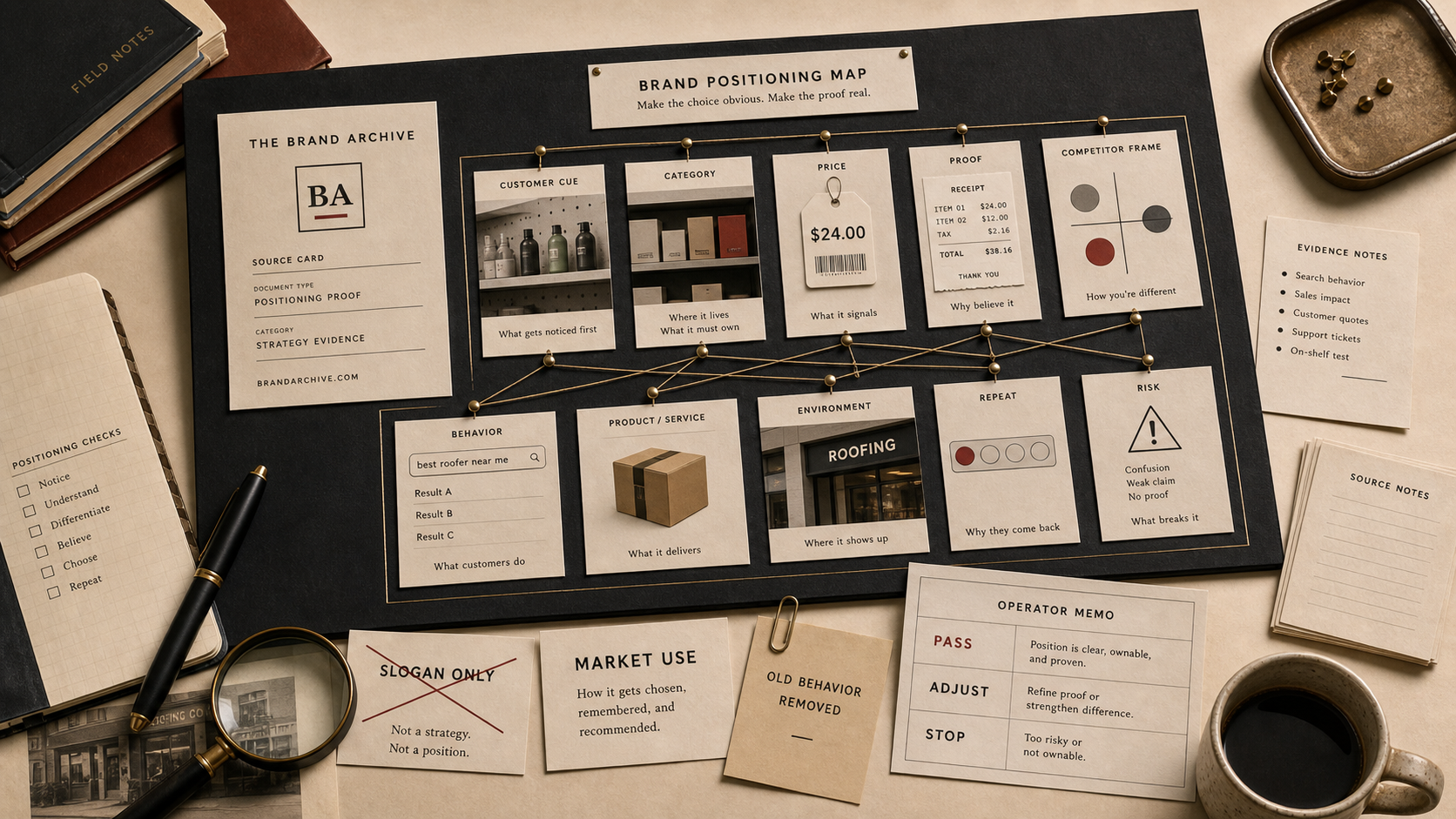
Direct Answer
Brand positioning is not the sentence inside the company. It is the choice frame in the customer's head. A position becomes real when customers know what the brand is for, what it should be compared with, and why its proof lowers the risk of choosing it.
Answer Map
Start with the decision, then check the proof.
Quote-ready definition
The Brand Archive definition
"The Brand Archive defines brand positioning as the place customers give a brand against alternatives, based on category, comparison, proof, price, risk, behavior, and reason to choose."
Why it matters
Why it matters
Positioning matters because buyers compare. They compare the brand with a competitor, a habit, a cheaper option, a safer option, a premium option, or doing nothing.
Mistake to catch
The expensive mistake
The common mistake is writing a position before finding the comparison. Without the comparison, the position has no pressure to survive.
Comparison
Brand positioning tests the comparison
A position is useful when it tells the customer what to compare, why the choice is different, and what proof makes the risk acceptable.
| Positioning layer | What to inspect | Archive proof |
|---|---|---|
| Category frame | What shelf, search term, or buying situation the customer uses first. | Liquid Death, Stripe |
| Alternative | The named competitor, old habit, default tool, or do-nothing option. | JCPenney, Rabbit R1 |
| Reason to choose | The proof that makes the position more than a claim. | Volvo, FedEx |
| Risk lowered | The practical fear the position reduces: money, time, safety, fit, status, or complexity. | Toyota, Zappos |
| Cue system | The name, phrase, package, interface, or behavior that retrieves the position under weak attention. | Mastercard, Tiffany |
Proof matrix
Positioning proof cases
Use these files to separate a real market position from a line written for the company.
| Case | What happened | What it proves | Operator lesson |
|---|---|---|---|
| Volvo Trust System / 1959-present |
Safety moved from claim to physical proof through the three-point belt. | A position gets stronger when the proof can be touched, named, or repeated. | Do not position on trust unless the buyer can see the trust mechanism. |
| Liquid Death Launch / 2019 |
Canned water borrowed entertainment and beer-category cues without changing the product into alcohol. | The comparison set can change perceived value before the product changes. | Pick the comparison the customer will actually read, not the category the team inherited. |
| Stripe Brand System / 2010 / 2011-present |
Payment moved into a developer-infrastructure frame. | Positioning can be built around the buyer who reads the pain most clearly. | Name the user, the job, and the proof before polishing the sentence. |
| JCPenney Failure / 2012 |
The value frame changed while customers still understood the old deal-hunting habit. | A new position can fail when it breaks the buying behavior that made the old one legible. | Audit the current habit before replacing the comparison. |
| Rabbit R1 Failure / 2024 |
A new AI device had to compete with the phone in the customer's head. | The hidden alternative can outrank the declared category. | Ask what the customer will compare this with in the first five seconds. |
Decision framework
How to use it
The practical test is whether the concept changes a real decision.
- Name the real alternative Is the brand fighting a competitor, a habit, a substitute, a cheaper option, or doing nothing?
- Choose the comparison frame Which category or buying situation should the market use before the brand explains itself?
- Name the risk What practical risk does the position reduce for the customer?
- Attach proof What product, service, operating, price, or source proof makes the claim believable?
- Check retrieval Can search, sales, customers, and AI summaries repeat the position without adding vague language?
Common mistakes
Mistakes to avoid
These mistakes are common because they sound reasonable inside the company and fail when customers meet the brand.
Starting with the sentence
Start with the alternative and the proof. Write the sentence last.
Ignoring the do-nothing option
For many buyers, the strongest competitor is staying with the current habit.
Using category words nobody searches
Use the words customers already use before teaching a sharper frame.
Positioning on an unsupported emotion
Tie the reading to proof: safety, time, repair, service, ownership, or risk reduction.
Changing the comparison without changing behavior
A new position needs a cue or proof shift the market can inspect.
Operator test
Operator test
Use the checklist as a pressure test. If the answer is vague, the brand decision is not ready.
- Name the alternative in the customer's head.
- Name the risk the position lowers.
- Name the proof customers can inspect.
- Name the cue that makes the position easy to recall.
- Check whether the position still works when attention is weak.
Related Files
Keep the answer inside the archive.
What Is Brand Positioning? FAQ
What is brand positioning?
Brand positioning is the place customers give a brand against alternatives.
Is positioning the same as a tagline?
No. A tagline can express a position, but the position lives in customer comparison and proof.
What makes positioning work?
Positioning works when category, comparison, cue, proof, and behavior all point to the same choice.