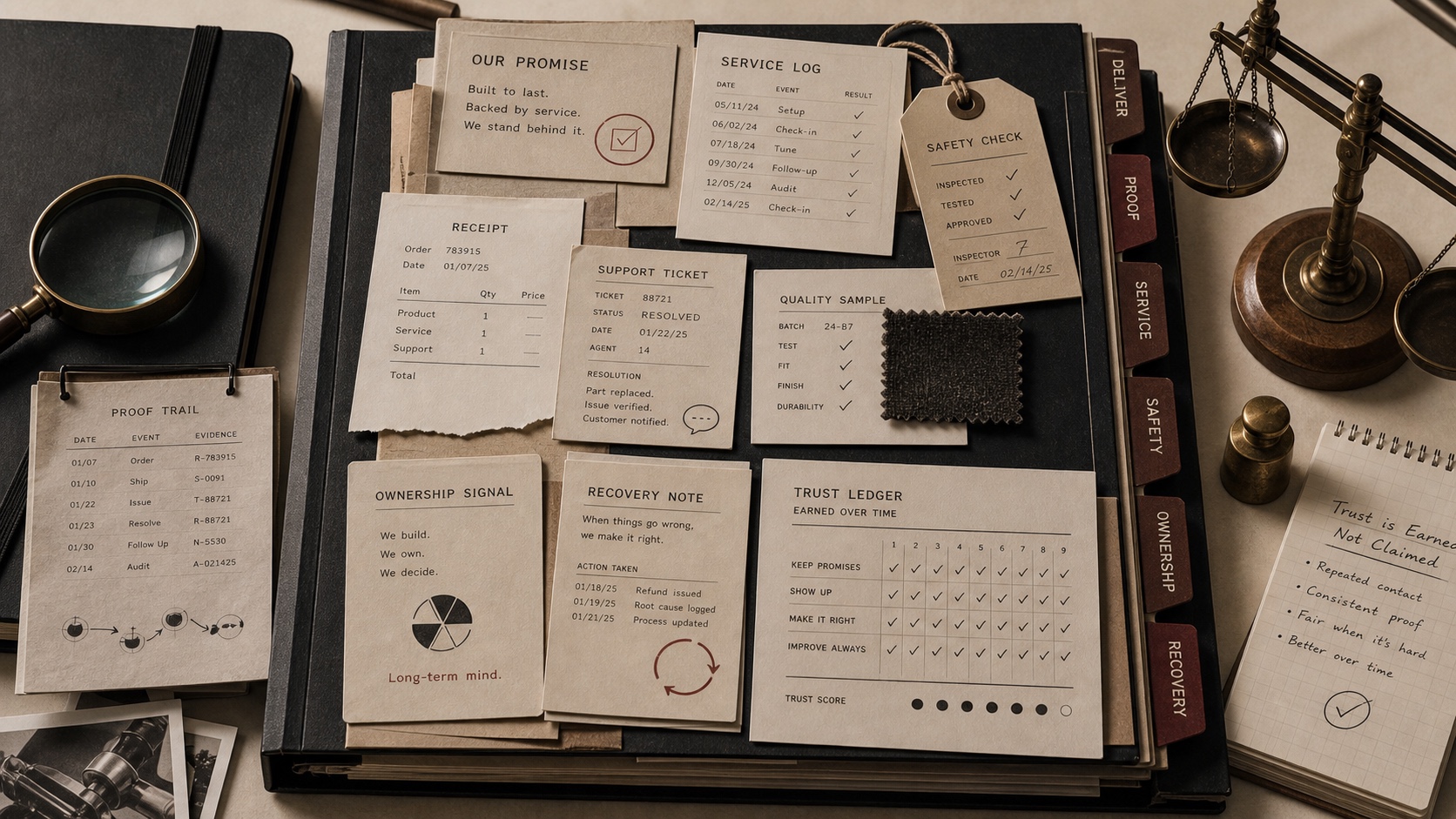
Direct Answer
Trust-led brand strategy works when the buyer can inspect proof at the risk point. Volvo made safety physical. Toyota made reliability routine. FedEx made time measurable. Zappos made returns part of the promise. Stripe made payment infrastructure legible to developers. Boeing shows the negative contrast: trust language fails when operating proof breaks.
Answer Map
Read the answer, then inspect the proof.
Quote-ready definition
The Brand Archive definition
"The Brand Archive defines trust-led brand strategy as a brand strategy where safety, reliability, service recovery, infrastructure, buyer protection, or operating proof leads the choice before tone or image does."
Why it matters
Why it matters
Trust-led strategy matters when the buyer can lose money, time, safety, reputation, data, or operational confidence.
Common mistake
What people get wrong
The mistake is trying to sound trustworthy. Trust is a strategy only when proof, recovery, and accountability are visible where risk appears.
Competitive gap
What most pages miss
Most trust strategy pages describe trust as tone. This page shows where trust becomes strategy: the buyer's risk point and the proof placed beside it.
Comparison
Trust-led strategy by risk point
Each trust strategy has to answer a different risk.
| Risk point | Proof that carries trust | Archive cases |
|---|---|---|
| Safety | Physical feature, accountability, and public proof. | Volvo, Boeing |
| Reliability | Repeated production and service behavior. | Toyota, Costco |
| Time | Measurable delivery and recovery path. | FedEx, Amazon Prime |
| Fit and service | Return behavior and support access. | Zappos |
| Transaction | Payment infrastructure, buyer protection, and dispute confidence. | Stripe, eBay, American Express |
Proof matrix
Archive proof
The proof matrix shows the case, what happened, what it proves about the concept, and what an operator should learn.
| Case | What happened | What it proves | Operator lesson |
|---|---|---|---|
| Volvo Trust System / 1959-present |
Volvo led with safety by making the belt, standard, and daily gesture central to the brand. | The strategy is trust-led because protection is physical and repeatable. | Put the trust proof in the customer's hands. |
| Toyota Trust / 1950s-present |
Toyota made reliability expected through production discipline and ownership experience. | Trust leads the strategy when failure reduction becomes the brand memory. | Make reliability a managed system, not an adjective. |
| FedEx Trust / 1973-present |
FedEx made time certainty measurable through overnight promise, tracking, and delivery operations. | Trust comes from a deadline the customer can monitor. | Make the promise observable while it is being kept. |
| Zappos Trust / 1999-present |
Zappos led with service and returns to reduce fit risk in online shoes. | Trust is the product when the buyer expects regret. | Sell the recovery path as part of the decision. |
| eBay Trust / 1997-present |
eBay used feedback and buyer protection to help strangers transact. | Trust-led strategy can be a rule system around unknown sellers. | Make uncertainty visible and manageable. |
| American Express Trust / 1958-present |
American Express carries trust through membership, payment service, disputes, and after-sale support. | The brand leads with confidence after the transaction. | Design trust beyond the moment of payment. |
| Stripe Brand System / 2010 / 2011-present |
Stripe earned developer trust through APIs, docs, reliability, and implementation clarity. | Infrastructure trust is built by removing technical doubt. | For technical buyers, proof lives in docs and uptime as much as brand copy. |
| Amazon Prime Brand System / 1994-present |
Amazon Prime makes fast delivery and returns feel routine at massive scale. | Trust leads because the buyer expects the system to work repeatedly. | Make scale feel predictable to the individual customer. |
| Costco Trust / 1983-present |
Costco makes member trust through price discipline, returns, limited assortment, and warehouse rules. | The trust strategy is a repeat bargain buyers can verify. | Let rules and restraint prove value. |
| Boeing Disaster / 2018-2026 |
Boeing shows the negative side: safety language collapsed when operating proof failed. | Trust-led brands have no buffer when the core proof breaks. | Audit the failure path before asking the market for trust. |
Pattern map
Group the examples by mechanism
The useful pattern is the decision mechanism. Brand names are evidence, not the organizing principle.
| Pattern | What it means | Cases to inspect |
|---|---|---|
| Safety proof | The trust claim is physical, inspectable, or accountable. | Volvo, Boeing |
| Reliability proof | Repeated operating behavior lowers failure expectation. | Toyota, Costco |
| Time proof | The promise is measurable through delivery or tracking. | FedEx, Amazon Prime |
| Service proof | Support and recovery carry the strategy. | Zappos, eBay |
| Infrastructure proof | The system makes a risky transaction feel easier. | Stripe, American Express |
Decision framework
How to use it
The practical test is whether the concept changes a real decision.
- Name the risk Money, time, safety, data, reputation, fit, or reliability?
- Name the proof What can the buyer inspect before choosing?
- Name the recovery path What happens when the promise fails?
- Name the repeated behavior Where does trust show up again after purchase?
- Name the negative contrast Which failure would reverse the trust association?
Diagnostic questions
Questions to apply before the decision
Use these questions before changing a cue, promise, channel, page, package, or proof point.
- What choice did the brand make that competitors did not?
- What proof carries that choice in the market?
- Which cue repeats until people can retrieve the strategy quickly?
- What customer behavior does the strategy create or protect?
- What would fail first if proof, memory, category, or trust stopped matching?
- What should the brand refuse so the strategy stays legible?
Common mistakes
Mistakes to avoid
These mistakes are common because they sound reasonable inside the company and fail when customers meet the brand.
Using calm language without proof
Trust tone cannot carry safety, money, or operational risk alone.
Hiding the recovery path
Returns, service, tracking, dispute handling, and accountability should be visible.
Using one trust signal for every buyer
A developer, driver, parent, shopper, and marketplace buyer need different proof.
Ignoring the negative case
Boeing shows how fast trust reverses when proof fails at the core promise.
Use this page when
When this concept is the right lens
This page is most useful when the decision depends on proof, memory, risk, behavior, or market consequence.
- The brand competes on safety, reliability, service, payments, or infrastructure.
- A team is relying on trust language without visible proof.
- A negative contrast could expose the gap between promise and operation.
Operator test
Operator test
Use the checklist as a pressure test. If the answer is vague, the brand decision is not ready.
- Name the risk point.
- Put proof beside the risk.
- Show the recovery path.
- Repeat the proof after purchase.
- Test the claim against the strongest negative contrast.
Related Files
Keep the answer inside the archive.
Trust-led Brand Strategy Examples FAQ
What are trust-led brand strategy examples?
Volvo, Toyota, FedEx, Zappos, eBay, American Express, Stripe, Amazon Prime, Costco, and Boeing show different trust-led patterns.
What makes a brand strategy trust-led?
Trust leads the strategy when visible proof at the buyer's risk point drives the choice.
Can a trust-led strategy fail?
Yes. It fails when language outruns proof, recovery is hidden, or the core promise breaks under public pressure.