Direct Answer
Useful successful rebrand examples include Accenture, Burberry, Old Spice, Domino's, Mastercard, Airbnb, and Burger King. They worked because the change had a job: separate from old risk, repair product proof, restore relevance, simplify an already learned symbol, clarify a marketplace promise, or return to category codes people could recognize.
Reader payoff
By the end of this page, you should be able to
- Separate successful rebrands by mechanism instead of praise.
- Find what each brand preserved before looking at what changed.
- Use the examples to decide whether a proposed rebrand has enough proof behind it.
- Spot when a positive case is a bad fit for the decision in front of you.
Answer Map
Start with the decision, then check the proof.
Quote-ready definition
The Brand Archive definition
"The Brand Archive defines successful rebrand as a brand change that makes the company easier to recognize, trust, place, or use because the new signal is supported by real proof and repeated behavior."
Why it matters
Why it matters
Successful rebrands matter because they show identity change can create value when it is tied to evidence.
The pattern is not freshness. The pattern is continuity plus proof: keep the cue that still works, change the part that creates friction, and show the market why the new signal is easier to trust.
Mistake to catch
The expensive mistake
The common mistake is copying the visual surface.
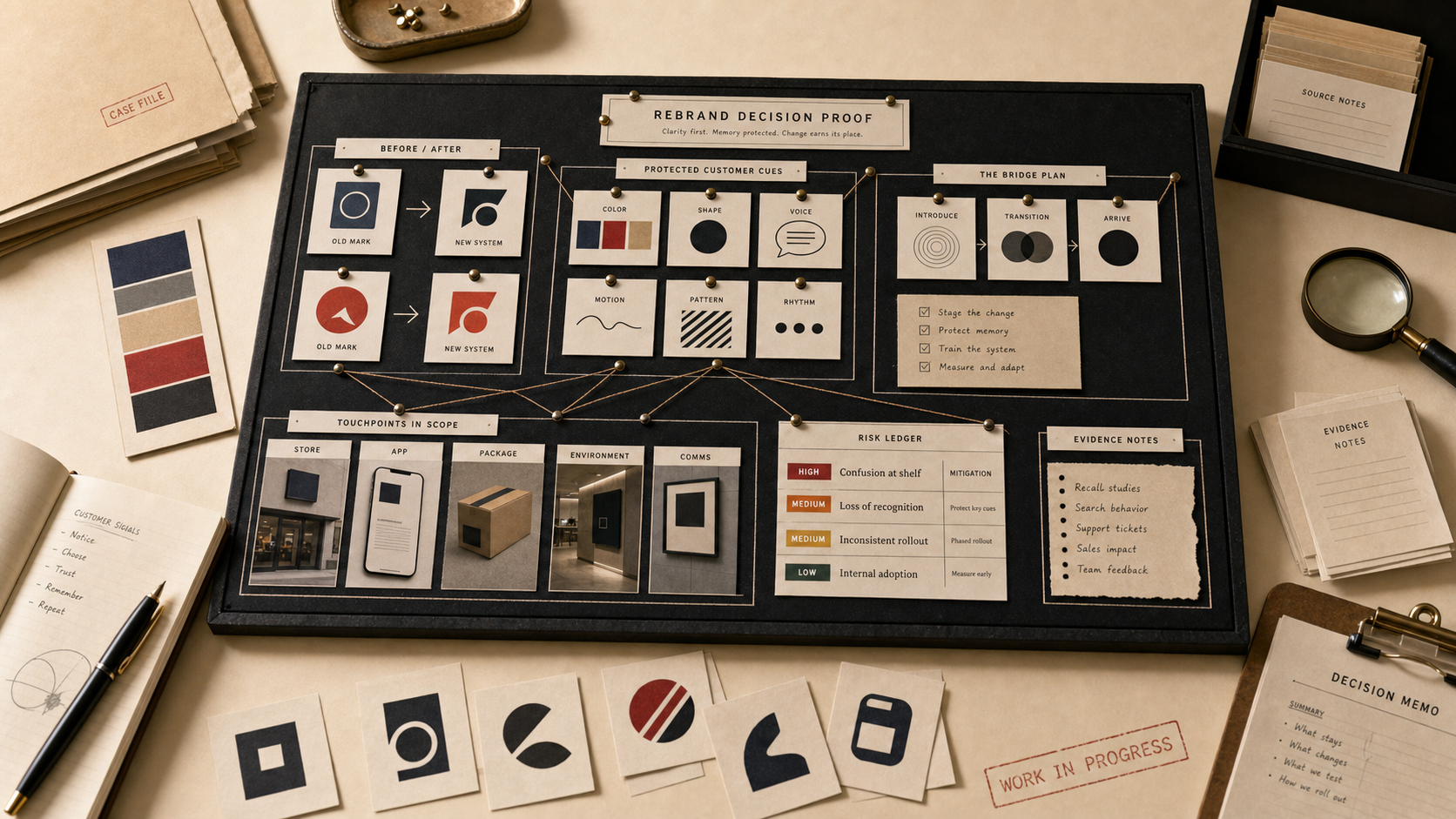
A successful rebrand is not a style to imitate. It is a migration system: old memory, new proof, customer behavior, and a reason to relearn.
Competitive gap
What most pages miss
Most successful-rebrand pages praise the finished identity. This page asks what continuity survived, what proof changed, and what customer behavior made the new system easier to accept.
Comparison
Successful rebrands by what made them work
Use the table to separate terms that often get collapsed together.
| Success mechanism | What the brand changed | What had to stay true |
|---|---|---|
| Separation from old risk | A new name or identity creates a cleaner public file. | The reason for the break must be easier to understand than the old name. |
| Proof-backed comeback | The story changes after the product, service, or operation changes. | Customers need evidence before they are asked to forgive. |
| Cue simplification | The identity removes words, detail, or clutter. | The remaining cue must already be learned across real surfaces. |
| Category clarification | The new system helps people place the brand in a broader market. | The product and service behavior must support the broader claim. |
| Heritage recovery | The brand returns to older codes that fit current use. | Heritage must clarify the present choice, not hide weak progress. |
| Relevance reset | Tone, channel, or audience behavior changes. | The brand still needs a product and category reason to be taken seriously. |
Proof matrix
Successful rebrand examples with the mechanism named
The proof matrix shows the case, what happened, what it proves about the concept, and what an operator should learn.
| Case | What happened | What it proves | Operator lesson |
|---|---|---|---|
| Accenture Rebrand / 2001 |
Accenture used a forced rename to separate from old Andersen Consulting risk and build a new consulting file. | The rename worked because the reason for change was clear and the old name had become a liability. | Make the strategic reason easier to understand than the old identity. |
| Burberry Comeback / 2000s |
Burberry repaired product control, distribution, and fashion credibility while changing public meaning. | The rebrand worked because proof moved through product and channel behavior. | Reset image only when the business can show the change. |
| Old Spice Comeback / 2010 |
Old Spice changed tone, channel behavior, and product context to make an old grooming brand socially shareable again. | The comeback worked because personality met a current category route. | Use voice to change behavior instead of treating campaign mood as the strategy. |
| Domino's Comeback / 2009 |
Domino's admitted product weakness, changed the recipe, and used the rebrand to show the repair. | The rebrand worked because proof preceded the story. | Let customers inspect the fix before asking for new trust. |
| Mastercard Rebrand / 2016-2019 |
Mastercard simplified toward a wordless mark after the red and yellow circles were already trained across payment surfaces. | The change preserved recognition while reducing clutter. | Simplify only after the cue can survive without explanation. |
| Airbnb Rebrand / 2014 |
Airbnb's Belo gave the marketplace a belonging frame while host, guest, and trust systems carried the promise. | The rebrand worked where the symbol connected to real marketplace behavior. | A new identity needs a behavior that makes the meaning believable. |
| Burger King Rebrand / 2021 |
Burger King returned to warmer food and heritage cues that fit packaging, restaurants, and category memory. | The refresh worked by restoring useful recognition instead of chasing novelty. | Use heritage when it makes the current choice clearer. |
Pattern map
Group the examples by mechanism
The useful pattern is the decision mechanism. Brand names are evidence, not the organizing principle.
| Pattern | What it means | Cases to inspect |
|---|---|---|
| Recognition risk | A new identity weakens a cue customers already use. | Gap, Tropicana, X |
| Proof burden | The new identity asks the operation to prove a stronger claim. | BP, Domino's, Accenture |
| Name and language change | Public vocabulary keeps retrieving the old file after the company changes the label. | X, Accenture |
| Search and AI memory | Search results, media language, and answer systems keep old files alive after launch. | X, Airbnb, Accenture |
| Customer habit break | The change interrupts a trained behavior before the replacement habit is clear. | New Coke, Qwikster, JCPenney |
| Strategic reframe | The rebrand works only when it points to a real operating or category move. | Airbnb, Domino's, Burger King |
| Asset simplification | A simpler mark works only after recognition has been earned. | Mastercard, Starbucks |
| Rollback control | The team knows what signal will slow or reverse the rollout before memory damage spreads. | Gap, Tropicana, Leeds United |
Diagnostic questions
Questions to apply before the decision
Use these questions before changing a cue, promise, channel, page, package, or proof point.
- Which cue is being changed, and what job does it already perform?
- What public memory could push back against the new identity?
- What proof must exist before the change asks for new trust?
- Does the rebrand clarify a real strategy or only refresh the surface?
- Which customers, channels, and search results will keep using the old file?
- Which AI or search answer could still describe the brand by its old name or old meaning?
- What customer habit could the change interrupt?
- What stop rule would prevent a recognition asset from being damaged?
Common mistakes
Mistakes to avoid
These mistakes are common because they sound reasonable inside the company and fail when customers meet the brand.
Copying the look without the condition
Name the business condition that made the example work: forced separation, product repair, earned recognition, category growth, or heritage fit.
Calling a redesign successful too early
Wait for the market behavior: search clarity, recognition, sales pressure, adoption, channel support, or repeated use.
Removing memory while chasing modernity
Protect the cue that still helps customers find, trust, or explain the brand.
Treating positive press as proof
Positive launch coverage is weak evidence unless it is followed by customer behavior or operating proof.
Use this page when
When this concept is the right lens
This page is most useful when the decision depends on proof, memory, risk, behavior, or market consequence.
- A rebrand needs positive examples without ignoring risk.
- A team wants to know whether a new identity can preserve old memory while changing direction.
- The question is what proof made the change credible.
Operator test
Operator test
Use the checklist as a pressure test. If the answer is vague, the brand decision is not ready.
- Find the business change under the identity change.
- Protect the cue the market already knows.
- Check whether the new system makes the category clearer.
- Use proof before personality.
- Do not copy another rebrand without copying its evidence burden.
- Name the continuity bridge before approving the new identity.
- Decide which behavior will prove the rebrand worked: recognition, search, purchase, adoption, retention, channel support, or public language.
- Compare the proposed change against one failed rebrand so the team sees the cost of removing useful memory.
Source trail
Sources used to check the page claims.
- Accenture history
Use this as the source trail for the post-Andersen identity file and the company record behind the rename.
- Domino's company history
Use this as the source trail for the public turnaround record and product-change context behind the comeback.
- Mastercard brand mark announcement
Use this as the source trail for cue simplification after the red and yellow circles had enough recognition to stand alone.
- Airbnb Belo launch record
Use this as the source trail for the marketplace identity shift toward belonging and the broader category promise.
- Burger King brand refresh announcement
Use this as the source trail for the return to food, heritage, packaging, restaurant, and digital cues.
- Burberry company history
Use this as the source trail for heritage, product credibility, and the public brand record behind Burberry's reset.
Related Files
Keep the answer inside the archive.
Examples of Successful Rebrands FAQ
What are examples of successful rebrands?
Accenture, Burberry, Old Spice, Domino's, Mastercard, Airbnb, and Burger King are useful examples.
What makes a rebrand successful?
A rebrand works when the new identity is supported by real proof, protected recognition, and repeated behavior.
Can a rebrand work without a business change?
Sometimes, but the burden is higher. The market needs a reason to relearn the cue.