Direct Answer
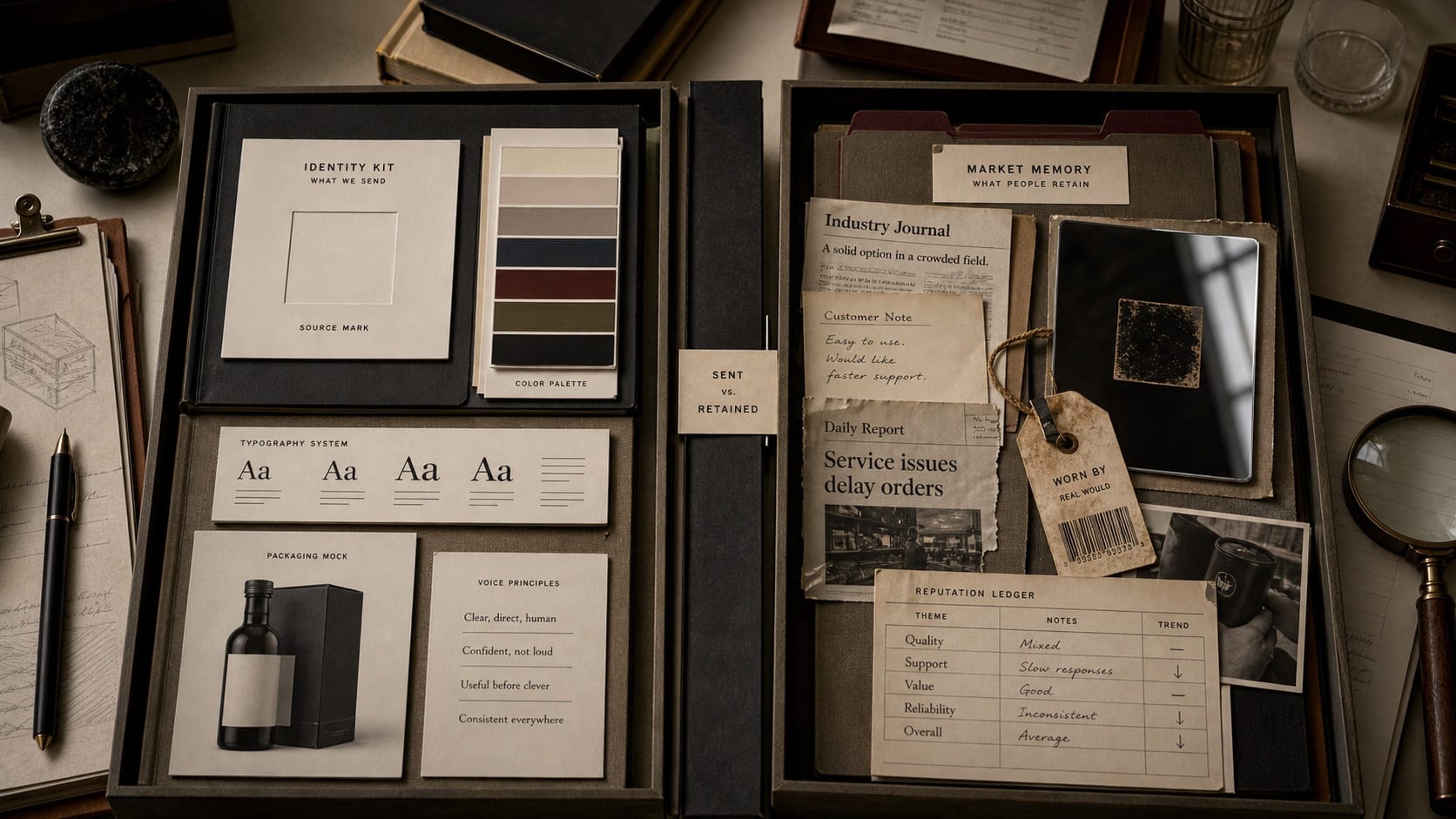
Brand identity is the system a company controls: name, logo, color, type, voice, imagery, packaging, product behavior, service standards, and proof rules. Brand image is what the market keeps after meeting that system.
Reader payoff
By the end of this page, you should be able to
- Separate identity from image, logo, guidelines, and reputation.
- Audit the elements customers actually encounter.
- Spot when an identity change is really a proof problem.
- Use cases before approving a new visual system.
Answer Map
Start with the decision, then check the proof.
Quote-ready definition
The Brand Archive definition
"The Brand Archive defines brand identity as the controllable set of cues a brand sends into the market, including name, marks, color, type, voice, product behavior, service rules, packaging, and proof standards."
Why it matters
Why it matters
Identity matters because customers often meet fragments, not the full brand book.
A logo may be seen without the name. A package may be seen from a distance. A support reply may carry more identity than a launch film. The identity system has to survive those ordinary surfaces.
Mistake to catch
The expensive mistake
The common mistake is treating brand identity as a logo file.
A logo can trigger recognition, but it cannot repair weak product proof, confusing naming, bad service, or a public image that contradicts the new system.
Competitive gap
What most pages miss
Most identity pages list elements. That is useful but incomplete.
The stronger question is which element the customer actually uses: name, mark, color, package, voice, product form, service behavior, or proof surface.
Comparison
Brand identity vs nearby terms
Use the table to separate terms that often get collapsed together.
| Term | What it controls | Archive test |
|---|---|---|
| Brand identity | The signals the company sends. | Do the cues stay coherent across real surfaces? |
| Brand image | The meaning the market keeps. | Does public memory match the intended identity? |
| Logo | One recognition cue. | Can it carry meaning without the full system? |
| Guidelines | Rules for using the system. | Do the rules protect the cues customers use? |
| Reputation | The public record of behavior. | Does the record support or contradict the identity? |
Proof matrix
Identity cases that prove the distinction
Each row states what happened, what the case proves, and what an operator should learn before copying the surface.
| Case | What happened | What it proves | Operator lesson |
|---|---|---|---|
| Mastercard Rebrand / 2016-2019 |
The circles could carry more work after years of card, checkout, and terminal repetition. | Identity simplification works after the market has learned the cue. | Do not remove the name until surrounding proof can carry recognition. |
| Gap Rebrand / 2010 |
A cleaner logo removed a familiar blue-box cue and reversed quickly. | Internal identity taste can misread public memory. | Audit the old cue before calling it outdated. |
| Tropicana Failure / 2009 |
The package changed and the shelf shortcut broke. | Packaging can be an identity element when it helps customers find the product. | Test identity changes in the buying environment. |
| Airbnb Rebrand / 2014 |
The Belo identity tried to make belonging the frame for a marketplace that still needed trust proof. | Identity needs service behavior to make the idea believable. | Pair emotional identity with the operating proof that reduces risk. |
| X Rebrand / 2023 |
The new identity fought the old name, verb, media language, and user habit. | A sent identity can lose to retained public image. | Plan the bridge from old language to new meaning. |
| FedEx Trust / 1973-present |
Name, wordmark, service promise, tracking, and delivery behavior stayed close together. | Service behavior can be part of identity when it repeats at the risk point. | Let operations carry identity where the customer checks the promise. |
Pattern map
Group the examples by mechanism
The useful pattern is the decision mechanism. Brand names are evidence, not the organizing principle.
| Pattern | What it means | Cases to inspect |
|---|---|---|
| Recognition cue | A mark, color, package, or shape helps fast identification. | Mastercard, Gap, Tropicana |
| Service identity | The operating behavior is part of the signal. | FedEx, Zappos |
| Image conflict | The market keeps a different meaning than the company sends. | X, BP, Boeing |
| Emotional identity | A symbol asks for a feeling that service must prove. | Airbnb, Patagonia |
Decision framework
How to use it
The practical test is whether the concept changes a real decision.
- List the elements Name the controllable cues: name, logo, color, type, voice, product, package, service, proof.
- Find the live surface Where does the customer actually meet each cue?
- Check public image What meaning does the market keep, regardless of the brand book?
- Protect useful cues Which old cue still helps people find or trust the brand?
- Fix proof before polish Which identity problem is really a product, service, or trust problem?
Diagnostic questions
Questions to apply before the decision
Use these questions before changing a cue, promise, channel, page, package, or proof point.
- Which identity element does the customer recognize fastest?
- Which element is doing more work than the brand team admits?
- Does the new system match the product and service evidence?
- What public image will fight the intended identity?
- Where will the identity appear small, cropped, silent, delayed, or handled by a partner?
Common mistakes
Mistakes to avoid
These mistakes are common because they sound reasonable inside the company and fail when customers meet the brand.
Calling the logo the identity
Audit name, color, voice, product behavior, service, package, and proof together.
Changing identity before image
Find the public meaning that will resist the new system.
Designing for the deck
Test shelf, app, support, invoice, social crop, and search surfaces.
Ignoring old equity
Keep or bridge cues customers still use to choose.
Operator test
Operator test
Use the checklist as a pressure test. If the answer is vague, the brand decision is not ready.
- Write every identity element that reaches customers.
- Circle the elements customers use before reading.
- Compare intended identity with public image.
- Name the proof needed to make the identity believable.
- Set a rollback rule for recognition loss.
Related Files
Keep the answer inside the archive.
What is brand identity? FAQ
What is brand identity?
Brand identity is the controllable cue system a company sends into the market.
What are brand identity elements?
Common elements include name, logo, color, type, voice, imagery, packaging, product behavior, service rules, and proof standards.
Is brand identity the same as brand image?
No. Identity is what the company sends. Image is what the market keeps.
What is the biggest brand identity mistake?
The biggest mistake is treating identity as a logo file instead of a system customers meet across real surfaces.