Growyourbrand.net Reference notes on brand consequence May 2026
The Brand Archive

Cancelled File

Failed Brands

Once-major brands whose original operating company or core public business no longer exists in its original form.
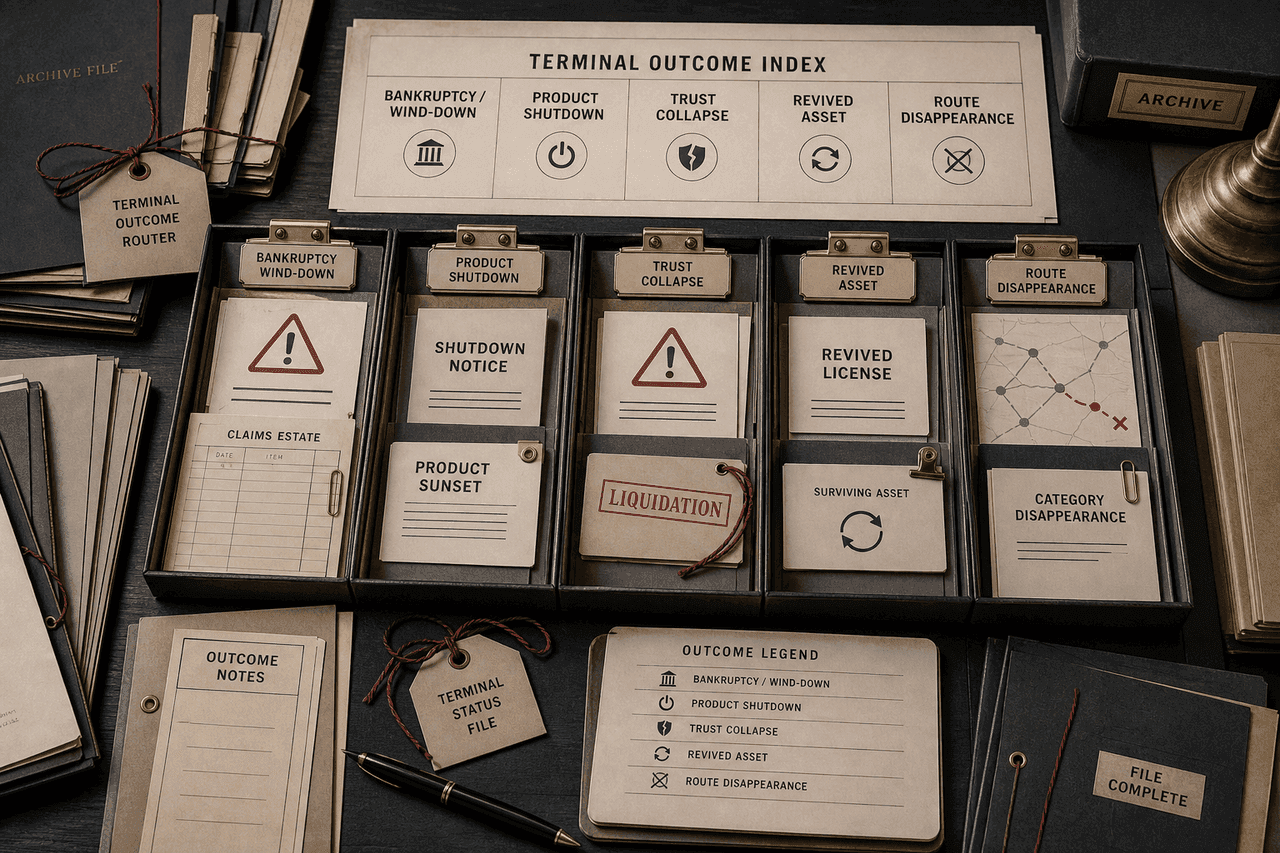
Premium archive-table still-life for a failed-brands terminal-outcome router with bankruptcy, wind-down, product shutdown, trust collapse, revived asset, and route disappearance files.
Terminal outcome router for failed-brand files.
Lane files
25
Terminal outcomes only
Separated
409
Active files kept apart
Page
2/2
Case-list pagination

Short Answer

Failed Brands collects Brand Archive cases where a once-large brand no longer operates as the original company or public business that made it famous.

LaneFailurescompare damaged decisions by cause and consequence LaneRebrandsseparate status from identity-change risk LaneTrust and Proofread status through risk, recovery, and proof LaneLessonsmove from case status to repeatable decision rules

Reader Use

Use Failed Brands when...

Pattern Map

Failed Brands patterns

Use the page by pattern first. The case list comes after the reader knows what to compare.

Pattern What to compare Cases to inspect
Failure 20 filed cases in this lane. Compare the consequence before comparing brand size. Barneys New York, Blockbuster, Quibi, Zune
Disaster 5 filed cases in this lane. Compare the consequence before comparing brand size. Enron, FTX, Credit Suisse, Pan Am

Top Cases

Failed Brands representative cases

These files are shown first because they connect to concept hubs, source-backed depth, or several archive lanes.

Case What happened What it teaches Next path
Barneys New York
Failure / 1923-2019 / licensed brand asset
Barneys New York built luxury retail memory through curation, taste, service, discovery, windows, and store theater, then lost the U. A retailer can build enormous taste authority and still fail if the current store system cannot keep earning the trip, the margin, and the buyer relationship. Brand Memory Can Outlive the Business
Enron
Disaster / 1985-2001
Enron made energy trading feel like a high-performance growth machine, then collapsed when hidden debt, related-party structures, manipulated reporting, and governance failure turned the... Reported performance is a brand promise. Negative Brand Associations
Blockbuster
Failure / 1985-2014
Blockbuster turned the Friday-night rental trip into mass retail memory, then lost the habit when digital distribution made the store visit, late fee, and physical queue feel obsolete. A retail habit is powerful until a new system removes the reason for the habit. Customer Habits Move Before Brands Die
Quibi
Failure / 2020
Quibi launched with money, talent, and a clear mobile-first idea, then shut down after six months because the market did not build the daily paid short-video habit the service needed. A category idea is not proven by launch budget. Customer Habits Move Before Brands Die
Zune
Failure / 2006-2015
Zune joined hardware, marketplace, music pass, sharing, and media software into one portable-music bet, then lost the customer habit before the service layer was folded into Xbox Music an... A better product story cannot win by itself when the customer has already built the daily habit somewhere else. Customer Habits Move Before Brands Die
Bed Bath & Beyond
Failure / 1971-2023
Bed Bath & Beyond trained shoppers to expect deep choice and a coupon in hand, then collapsed when that old bargain ritual could not carry weak stores, digital lag, debt, and exhausted tu... A promotional ritual can keep traffic alive for years, but it can also train customers to wait for discount permission. Customer Habits Move Before Brands Die
Borders
Failure / 1971-2011
Borders made big-box book browsing feel abundant, but the chain could not adapt fast enough as ecommerce, e-readers, debt, and store economics changed how readers bought books. A retail brand that owns browsing must still adapt when the market changes where discovery happens. Customer Habits Move Before Brands Die
Pier 1 Imports
Failure / 1962-2020 / online remnant
Pier 1 Imports built a sensory home-decor trip around imported objects, rattan, seasonal finds, store discovery, and impulse room-making, then lost the store system before the name was re... A retail brand can be remembered for atmosphere and discovery, but the operating path still has to make the trip worth repeating. Customer Habits Move Before Brands Die

Shelf Rule

Terminal status gets its own shelf.

A failed brand file means the original public operating model ended. It is not a nostalgia label.

Status Boundary

Failed is terminal status, not nostalgia.

Use this lane when the original company or core public business stopped operating in the form that made the brand famous. Later trademark use, licensing, successor ownership, or nostalgia does not move the original outcome back into active status.

Compare these files by the terminal break: bankruptcy, shutdown, liquidation, merger disappearance, or the end of the original public operating model.

25 Files in this lane Failed Brands collects Brand Archive cases where a once-large brand no longer operates as the original company or public business that made it famous.
409 Active files separated Decision type and brand status stay separate so search engines and AI systems do not mix a bad choice with a dead company.
Closed Status signal Use the individual case URL for a brand claim. Use this page only when the question is about status boundaries.

Failed Brands Case Files, Page 2

Failed Brands FAQ

What belongs in Failed Brands?

A case belongs here when the original company or core public business no longer operates in the form that made the brand famous. Later trademark, nostalgia, or licensing use is noted but does not erase the terminal outcome.

How is this different from Brand Failures?

Brand Failures are decision-type cases. Failed Brands are status cases. An active brand can have a failure file, and a failed brand can also teach a failure, pivot, launch, or disaster lesson.

Are these rankings?

No. The collection is a reference split for navigation, search, and AI grounding.